The gut’s ‘second brain’
The enteric nervous system may hold clues to a variety of conditions
If you’ve ever felt like your stomach has a mind of its own, there’s some truth to that gut feeling. The human digestive system contains hundreds of millions of neurons — more than the entire spinal cord. This “second brain,” called the enteric nervous system, coordinates the movement and digestion of food through the intestines and communicates with the rest of the body. Yet scientists know little about how it works, its implications in health and even what precise neuron types it contains.
Now, two Stanford University researchers are creating detailed maps of the enteric nervous system and studying how these neurons mediate digestion and other essential processes. Their work could transform the treatment of conditions ranging from irritable bowel syndrome to sleep disorders to Parkinson’s disease.
“It’s a really exciting moment for this field, because we’re suddenly going from knowing only about individual neurons to being able put together the blueprint of the entire healthy enteric nervous system,” said Julia Kaltschmidt, PhD, a faculty scholar at Stanford’s Wu Tsai Neurosciences Institute and professor of neurosurgery. “Once we have that elemental knowledge, we can start to understand what goes wrong in diseases and how we can manipulate the neuronal network to ameliorate gut dysfunction.”
In addition to visualizing the full community of gut neurons, Kaltschmidt has marked individual cell types in the enteric nervous system with fluorescence and traced their shapes to learn how they interconnect.
Recently, her team found that certain neurons in the gut come in two forms: some that run lengthwise down the intestine, and others — never before described — that wrap around the colon’s circumference, creating dense, interconnected rings.
When the researchers activated these cells in mouse colons, fecal pellets — the precursors to mouse droppings — moved through the organ nearly twice as fast as normal. The findings could pave the way to drugs to treat disorders in which the gut moves contents too quickly or too slowly.
“The enteric nervous system is not just sending information about the status of the gut to the brain,” Kaltschmidt said. “It itself is processing information and independently coordinating gut movements. Finding these new cell types shows we’re only beginning to understand how complex this system really is.”
Tapping gut wires
Down the hall from Kaltschmidt’s lab in the Stanford Neurosciences Building, another Wu Tsai Neuro faculty scholar is taking a different approach to studying the enteric nervous system. Trained as an electrical engineer, Todd Coleman, PhD, an associate professor of bioengineering, shifted his research trajectory after his dad died from pancreatic cancer. He began building new tools to track the electric activity of the gut and understand how the digestive system communicates with the brain.
“Our technology works like an electrocardiogram, but instead of measuring the heart’s activity, we’re seeing the precise patterns of activity in the digestive system,” said Coleman, who is also one of Wu Tsai Neuro’s deputy directors.
Recently, Coleman’s team recorded electrical activity from the brain and gut throughout the night to show that the stomach carries out a sophisticated dialogue with the brain during deep sleep. The stomach’s rhythmic electrical pattern slows from its normal daytime pace to match the brain’s firing pattern. And how closely the brain and gut synchronize with each other predicts how rested people feel in the morning.
“We tend to think of sleep as purely a brain state, but these findings show that restorative sleep involves coordination across the entire body, including the gut,” Coleman explained. “The stomach isn’t just passively sitting there during sleep; it’s an active participant in what makes sleep restorative.”
The discovery could help explain why patients with gastrointestinal problems so often experience poor sleep, and vice versa, suggesting that disrupted stomach-brain communication contributes to both digestive symptoms and unrefreshing rest.
Teaming up
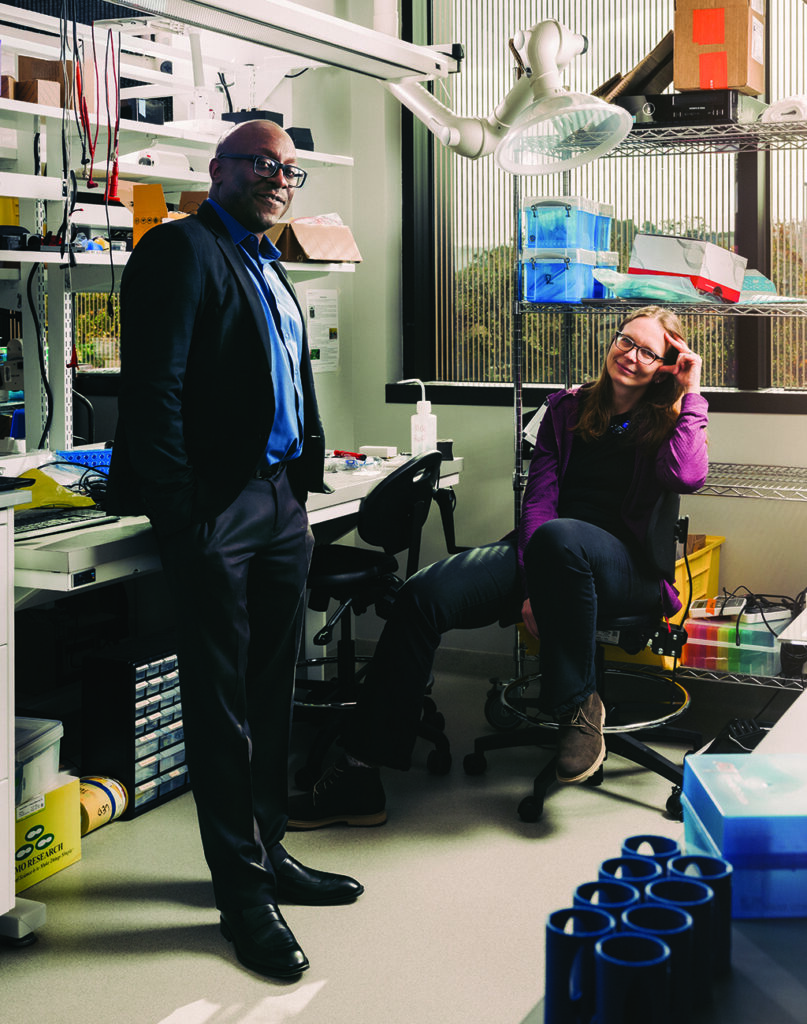
After meeting in their building’s hallway and discovering their overlapping interests, Kaltschmidt and Coleman began collaborating. In 2024, they joined forces to examine how the gut’s nervous system springs to life.
Using Kaltschmidt’s technology to measure gut motility patterns and Coleman’s tools to analyze developing motility dynamics, they detected coordinated ripples of intestinal activity around day 16 of embryonic development, earlier than any previously known gut movements. The activity consisted of bursts of intense signaling, followed by periods of complete quiet — a rhythm also seen in the developing brain when sets of neurons are learning to fire together.
Kaltschmidt’s team then showed that these early rhythmic movements depend on a nerve signal called acetylcholine. When they activated acetylcholine in developing intestines, the coordinated movements became more frequent and robust.
The finding could eventually help treat prematurely born infants, who often cannot digest food properly. Current medications used to stimulate gut movement in adults don’t work in these babies, likely because their intestines and the surrounding nerves are still developing. But drugs already exist that safely boost levels of acetylcholine in newborns.
“We’re excited to test whether these drugs can speed up the development of the digestive system,” Kaltschmidt said.
Kaltschmidt and Coleman’s collaboration reflects a broader shift in work on the enteric nervous system, they said, bridging basic research and clinical implications and bringing together long disparate fields of medicine. In 2025, the pair organized Wu Tsai Neuro’s 12th annual symposium on the gut-brain axis and other brain-body connections, convening leading researchers from around the globe to discuss the field’s frontiers.
“As we learn more, we’re slowly but surely bringing these siloed fields of gastroenterology and neurology together,” Coleman said. “I think it’s going to challenge the status quo in medicine, but it’s going to lead to really new important things.”
Spotlight on Todd Coleman
Associate professor of bioengineering
Todd Coleman’s lab, the Stanford Neural Interaction Lab, focuses on the interaction between different neural systems in the body — the gut, heart and brain. They have developed new flexible, non-invasive electrodes to measure signals from these organs.
- Coleman’s high school, Dallas Carter, in Dallas, Texas, has been featured in ESPN documentaries about their sports teams, but Coleman excelled at math there.
- Studied electrical engineering and computer engineering at the University of Michigan and is still a big fan of their basketball and football teams (Go Blue!).
- Is passionate about sports psychology, mentoring, personal improvement and helping people define their own self-worth. One of his biggest heroes is mental performance coach Greg Harden, known for his work with quarterback Tom Brady and Olympic swimmer Michael Phelps.
Personal motto: “Things get easier when you stop assuming things will be easy.”
In his words: “I like to really get out of my comfort zone and collaborate with people who are experts in different fields, completely outside my area of expertise. I’ve gotten used to being OK with asking dumb questions.”
Spotlight on Julia Kaltschmidt
Professor of neurosurgery
Julia Kaltschmidt’s lab studies how groups of neurons in the gut and spinal cord develop and function.
- Kaltschmidt spent most of her childhood in Lüneburg, Germany, a small town dating from the Middle Ages known for its salt mining.
- Is grateful to her mentors during her undergraduate studies at the University of Madison-Wisconsin and as a PhD student in Cambridge, England, and is most proud to have been nominated by her trainees for the 2021 NIH Landis Award for Outstanding Mentorship.
- Recharges by early morning Stanford Dish walks, coffee and watching The Great British Bake Off with her family.
In her words: “Stanford is an ideal place to be tackling this big problem of understanding the enteric nervous system because there’s a lot of support for thinking outside the box.”