


Feast and famine
Metabolism changes that occur as pythons gorge then fast provide insight into potential weight loss options
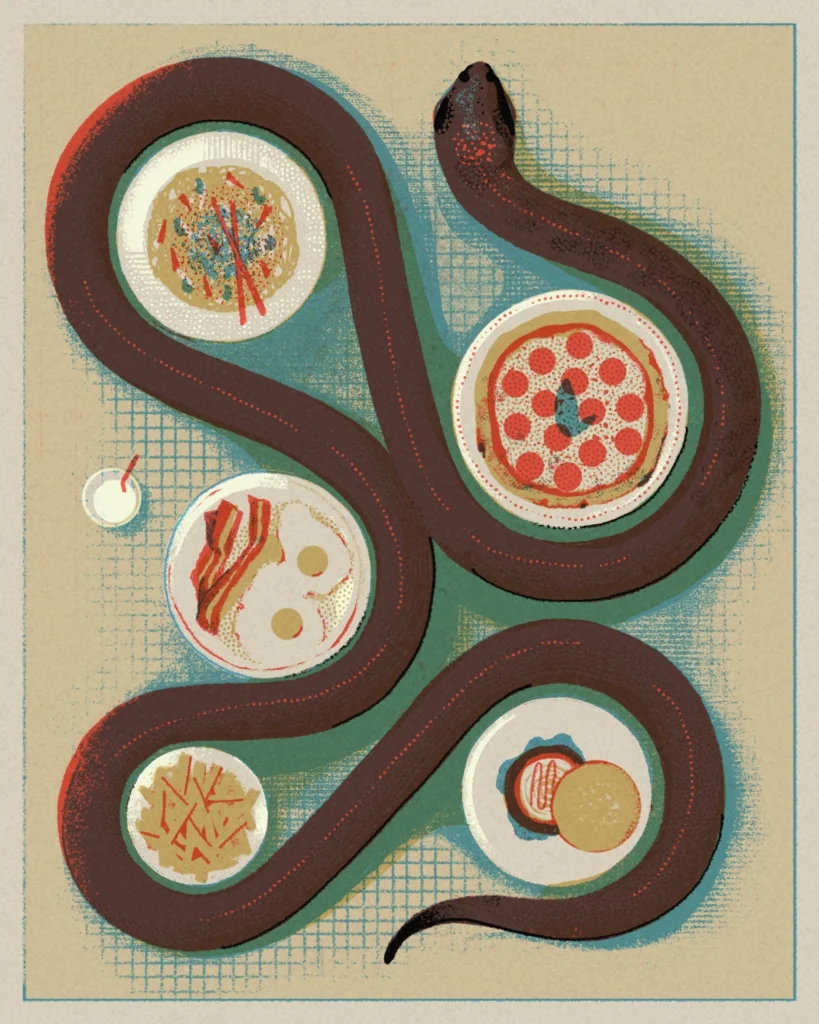
Pythons don’t nibble. They chomp, squeeze and swallow their prey whole in a meal that can approach 100% of their body weight. But despite stealthy slithering, months or even a year may pass between massive mouthfuls.
This pattern of extreme feasting and fasting taxes their metabolism far beyond what humans experience on a day-to-day basis.
Researchers at Stanford Medicine and the University of Colorado Boulder have found that a metabolite called pTOS, which spikes a thousandfold in pythons after a large meal, causes obese laboratory mice to shun their food pellets and lose weight — mimicking the effect of semaglutide drugs such as Ozempic and Wegovy. The research was published in March 2026 in Nature.
Although it’s too soon to tell whether pTOS will translate to a new weight loss drug in humans, the research solidifies the power of studying extremes in the animal kingdom.
“Obviously, we are not snakes,” said Jonathan Long, PhD, an associate professor of pathology and senior author of the study. “But maybe by studying these animals we can identify molecules or metabolic pathways that also affect human metabolism.”
Reptiles have repeatedly gifted humans with useful drugs. Snake venom is chock-full of biologically active compounds that have been developed into blood pressure medications and anticoagulants. And semaglutide arose from the discovery of a hormone in the Gila monster that regulates blood sugar levels.
“Mammals have a relatively narrow physiologic and metabolic range,”said Long, a member of the Wu Tsai Neurosciences Institute. “Humans, for example, eat around 1% to 2% of their body weight each meal, and we eat about three times a day,” unlike snakes, who eat rarely and whose physiology changes drastically after a meal.
Within hours after eating, the pythons’ organs, including their hearts, begin to expand in size by 50% or more, and cells that don’t normally divide, like the insulin-producing beta cells in the pancreas, explode in number.
Although more research needs to be conducted into the possible use of pTOS in humans to curb appetite, the pythons gave the researchers a plethora of additional molecules to study.
“We’re generating a landscape of molecules that vary in prevalence after eating in all organs of these snakes,” Long said. “We already found many that look like hormones but that have no similarity with any known hormones in mice or humans. This is a form of natural product discovery.”
Long and his colleagues speculate that some of these molecules could be clinically useful. “Maybe a patient with Type 1 diabetes due to defective beta cell function could benefit from a snake molecule that stimulates cell division, or a person with liver disease could take a snake-derived drug that facilitates organ remodeling,” Long said.
