

Getting to know your mitochondria
An excerpt from The Life Machines: How Taking Care of Your Mitochondria Can Transform Your Health
What are mitochondria, how can you keep yours happy and why would you want to? To answer these questions for curious readers without a science background, protein chemist Daria Mochly-Rosen, PhD, and her husband, writer Emanuel Rosen, wrote a book about these tiny structures that power our cells.
Mochly-Rosen, a Stanford Medicine professor of chemical and systems biology, has studied mitochondria for two decades — a period that has seen an explosion of research on the organelles and a boom in interest among the public. Yet, she has observed a major gap in knowledge about mitochondria and found it frustrating.
“Yes, mitochondria are the cells’ fuel sources, but we now know they are much more than that, said Mochly-Rosen, who is also the George D. Smith Professor in Translational Medicine. “They’re responsible for cleaning toxins from your cells, recycling some of the cell’s broken parts, fighting viruses, sending signals out about the status of your body — and that’s just some of what they do,” she said.
In their book, The Life Machines: How Taking Care of Your Mitochondria Can Transform Your Health, published in October 2025, the couple explain how the hundreds (and in some cases thousands) of mitochondria in each of our cells pull off what they’re best known for — converting what we eat into adenosine triphosphate, or ATP, a molecule that acts like the cell’s fuel. The couple also spell out mitochondria’s other roles and what we can do to help them out. That’s important, because, as they write: “Our life and death are quite actually in the hands of these tiny nanomachines.”
In this excerpt from the book, we gain a better view of how mitochondria constantly split and fuse — and how that choreography helps them repair damage, recycle faulty parts and keep them fit. And we learn why sleep is a mitochondrion’s friend.
The dance: They constantly split and merge
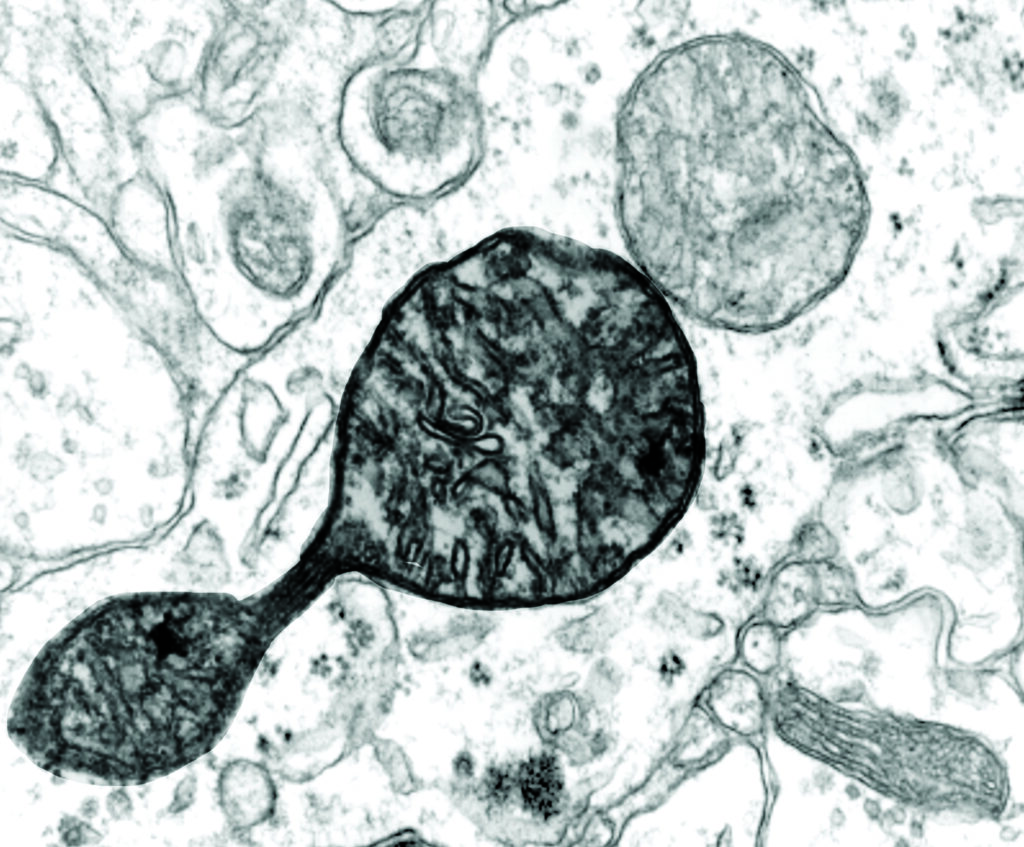
There’s a photograph on the wall of Daria’s office at Stanford that often stumps first-time visitors. It was taken with a powerful electron microscope that can magnify objects more than one hundred thousand times, and it features a figure-eight structure. When Daria asks guests what it is, they rarely identify it as a mitochondrion. They’re not alone: When Daria was first shown this photo 15 years ago and was told this was a mitochondrion, she remembers her succinct reaction: “Huh?” Most of us remember that static picture of a mitochondrion in our biology textbook, but the life machines change their shape all the time. The photograph in Daria’s office shows a mitochondrion going through fission, the process by which more mitochondria are generated. And mitochondria also merge with other mitochondria, a process known as fusion. Together, through this constant dance of fission and fusion — splitting and merging — the mitochondria’s ability to function properly is maintained.
The dance of fission and fusion is a fascinating process. Consider, for example, how a single mitochondrion decides whether it should merge with another mitochondrion. It starts with a handshake, during which each mitochondrion seems to check out the other one, as in speed dating. If either of them senses that the other one is not good enough, they move on, looking for a better partner. On the other hand, if merging is beneficial, they connect, fuse and start to exchange components to complement each other. Think about how this ingenious process helps the state of mitochondria in the cell and thus your health: A mitochondrion that is repeatedly rejected by others doesn’t get the good stuff from other mitochondria and eventually will be removed through mitophagy, the recycling program of mitochondria. In contrast, good mitochondria get better.
The process of fission, the division of a single mitochondrion into two, is no less fascinating. Fission is the way more mitochondria are generated, which is needed, of course, when the cell itself divides, which happens for some cells every 24 hours. But even when the cell does not divide, mitochondria need to split to remove damaged parts, in the same way that a tree needs to be pruned for optimal growth. This happens through the mitochondria’s recycling program — mitophagy.
Remarkably, before mitophagy can begin, our body separates between what needs to be recycled and what can still be used. Recall that mitochondria have their own small DNA (mtDNA). Unlike nuclear DNA, which has efficient machinery to prevent and correct mistakes, the mtDNA is much less efficient in taking care of such errors. This means that the mtDNA collects many mistakes throughout the life of each cell.
But here’s the good news: Unlike nuclear DNA, each mitochondrion has several copies of mtDNA. Therefore, in the same mitochondrion, you may have some lucky mtDNA that are still in good shape, and less fortunate ones that were damaged.
The same is true for the proteins in a mitochondrion. How is it then that mainly damaged mtDNA and damaged proteins are removed from a mitochondrion? This is yet another extraordinary process that happens inside our mitochondria. Damaged components assemble at one end of a mitochondrion while the intact mtDNA and proteins stay on the other end. Next, in coordination with another organelle called endoplasmic reticulum (ER), something like a noose is formed around the mitochondrion and cuts the mitochondrion into two mitochondria. The part that was pinched off contains the bad stuff while the other part is a healthy fresh mitochondrion ready for action. The bad section is collected by autophagosomes, which we can think of as garbage trucks, and brought to lysosomes, which we can think of as recycling centers. There, the damaged parts are digested into their building blocks, and those are later used to build new cell components.
How is this fascinating process relevant to your health? Here’s an example: During the day, mitochondria focus mainly on producing ATP and building blocks for all your daily activities; at night, while still generating ATP, they switch to a recovery mode — sorting the functional parts from the damaged ones and removing the damaged parts through mitophagy. So, when you get enough quality sleep at night, you give your mitochondria a chance to complete this pruning process.
Part of the “noose” that cleaves a mitochondrion into two mitochondria is a protein called Drp1, and researchers found that it receives signals from (and sends signals to) our body’s circadian clock (the internal clock that tells us when it’s time to sleep and when it’s time to get up). We’ll go into more details in chapter 9, but the key point is that getting enough quality sleep allows mitochondria to go through this deep cleanup. You should get enough sleep at night to let your mitochondria complete the job. SM
— Excerpted from The Life Machines: How Taking Care of Your Mitochondria Can Transform Your Health. Copyright © 2025, Mochly-Rosen, Daria and Emanuel Rosen. Reproduced by permission of Simon Element, an imprint of Simon & Schuster. All rights reserved.