


An ointment to quell atopic dermatitis
Quieting the intense itch of a common skin condition
The year was 1999 and Lucy Shapiro, PhD, was deeply troubled about the increasing ability of disease-causing microbes to defy the drugs used to thwart them. A professor of developmental biology at the Stanford School of Medicine, Shapiro responded by focusing on new anti-infective drugs.
Shapiro collaborated with Stephen Benkovic, PhD, a professor of chemistry at Penn State University, and Steve Baker, DPhil, at the time a postdoctoral researcher in Benkovic’s lab, who were two of the most visionary chemists she knew.
Their plan: At a drug’s active site, swap out carbon atoms for boron — its closely related neighbor on the periodic table. The logic: Carbon atoms are often at the active site of drug molecules. Replacement with boron would exploit boron’s chemical properties, which might knock out pathogens in new ways.
In 2002, Benkovic; Shapiro; and her husband and colleague, Harley McAdams, PhD, a professor of developmental biology, emeritus, co-founded Anacor Pharmaceuticals Inc. to develop boron-based drugs. Their most recent success is crisaborole, an anti-inflammatory that received approval in 2016 from the Food and Drug Administration to treat the most common form of eczema. Pfizer acquired Anacor shortly before the approval.
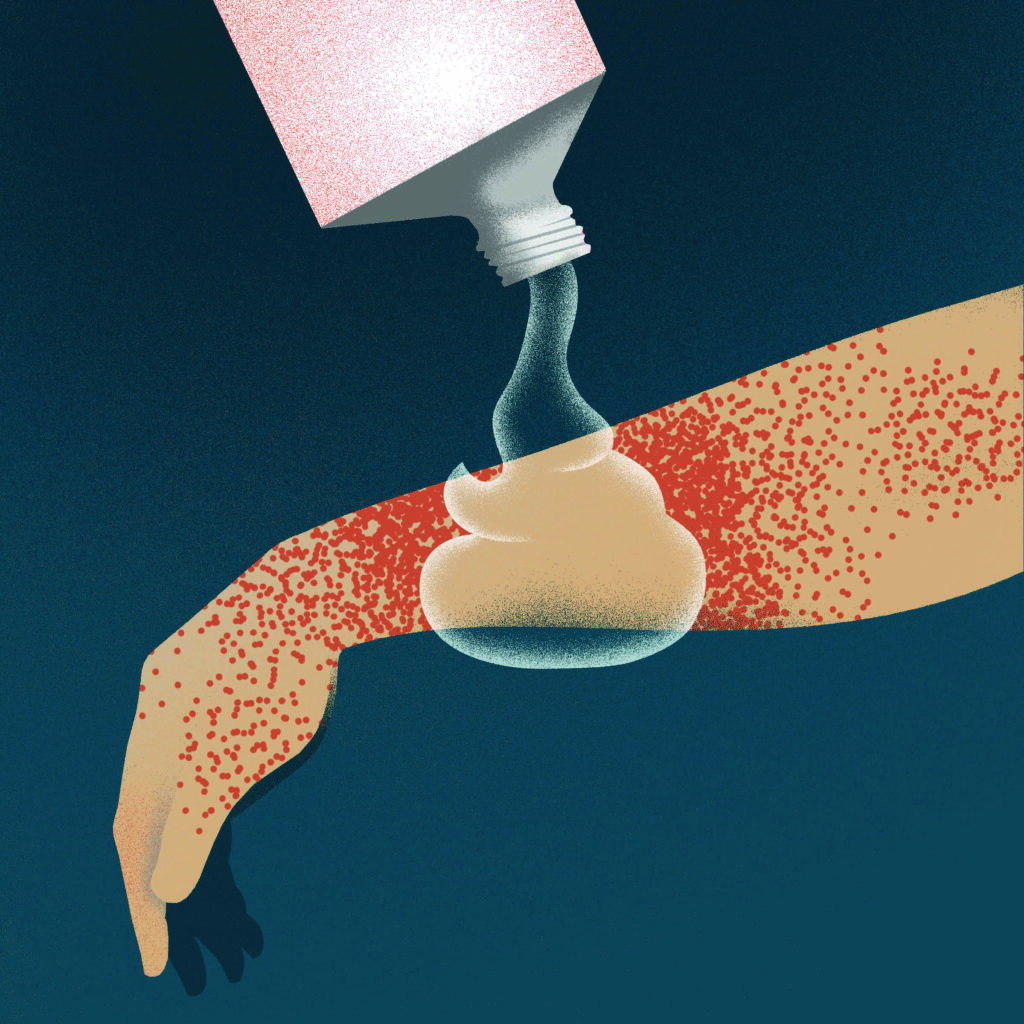
Applied as an ointment, crisaborole helps calm skin inflammation and itch due to mild-to-moderate cases of atopic dermatitis — a condition that predominantly affects children. Unlike steroids, the most common treatment for the condition, crisaborole is safe for long-term use.
In this Q&A Shapiro answers our questions about crisaborole.
What’s special about boron-based drugs?
The chemistry of boron is unique in its ability to change a compound’s molecular shape, allowing it to access unusual targets. Moreover, the presence of boron in a compound improves its ability to permeate the cell membrane.
How does crisaborole work?
It blocks an enzyme that interferes with the body’s natural process for calming inflammation. That enzyme, phosphodiesterase-4, or PDE4, breaks down a chemical, called cyclic AMP or cAMP, that generally reduces inflammation. In short, when crisaborole blocks PDE4, it allows cAMP to do its calming work.
You were trying to develop an anti-infective. How did you discover crisaborole’s anti-inflammatory potential?
It was a surprise. We had created a library of small chemical compounds in which carbon at the active site is replaced by boron. And we tested these against all manner of bacteria and fungi to identify any that could kill the pathogens. We also tested the compounds on human cells to be sure they didn’t adversely affect their growth or function.
One of the small compounds was crisaborole, applied topically, and that was pretty good at stopping strep infections of the skin in studies in the lab. Children with atopic dermatitis are susceptible to strep infection, so we conducted a Phase 2 clinical trial of crisaborole in that population.
Although it showed only mild effectiveness against strep in the participants, the trial showed — unexpectedly — that it was an effective anti-inflammatory. We established that this compound is a unique PDE4 inhibitor.
What challenges did you encounter: science, design, regulatory, funding?
We faced periodic challenges from all four, but we were fortunate enough to have an unusually capable CEO in David Perry, whose drive pushed all of us to overcome the roadblocks. Although we received our seed funding to develop new anti-infectives from the U.S. Department of Homeland Security (this was in 2001, after the bombing of the World Trade Center and the anthrax scares), I soon realized I wanted a company that designed drugs that would be available to everyone, worldwide. We live in a global village, and if we can’t stop an outbreak of disease in Nigeria or Toronto, we are not going to be able to control it here. So, Steve and I sought subsequent financial support for Anacor from venture capitalists.
How does it feel to have this treatment available for patients?
Deeply satisfying. Because crisaborole is a nonsteroidal treatment for atopic dermatitis, the impact has been considerable at the pediatric level. We have received numerous letters from parents who have been able to relieve the terrible rash and itching in their young children. As one mother said, “My daughter has finally been able to sleep at night.”
What’s next?
The success of crisaborole has led to the investigation of other PDE inhibitors, especially in neurological disease. In parallel with the discovery and development of crisaborole, Anacor also developed the first new antifungal in 25 years — tavaborole, which received approval from the FDA in 2014 to treat nail fungal infections.
At our current company, 5Metis Inc., boron chemistry is being applied to combat fungal infections of agricultural products, with significant success in the control of black sigatoka, a fungus that is killing the Cavendish banana worldwide. In addition, we are hoping to apply boron chemistry to antibiotic-resistant tuberculosis.
