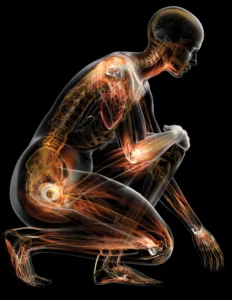
The genome in motion
DNA performs a dance that affects how cells function
Inside every cell in your body, DNA is dancing. Stretches of the genetic material loop, twirl and wave until two sections — distant on a linear strand of DNA but now flung into proximity — find each other. They touch briefly, exchange information, then spin away again.
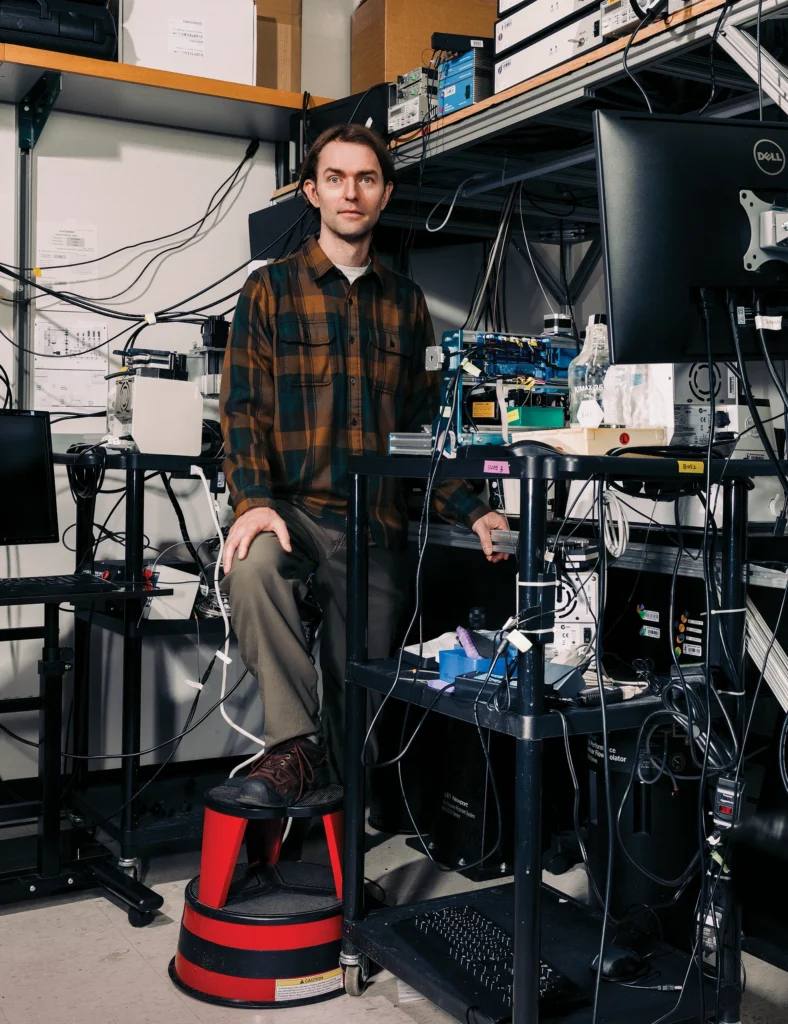
For decades, textbooks depicted our genome as a disordered tangle, a ball of spaghetti crammed into the nucleus with little organization. Alistair Boettiger, PhD, an associate professor of developmental biology, is among those scientists now proving that view wrong.
With ultrahigh resolution microscopy techniques his lab has pioneered, he has shown how DNA’s ever-moving structural dance is vital to cells’ functions. The choreography of DNA inside heart cells makes them different from liver cells or skin cells — and missteps could cause disease.
“We can now trace, in exquisite detail, the structure of DNA in hundreds of thousands of cells from different tissues,” Boettiger explained. “And it becomes clear that there is order to this structure; it is not a molecule crumpled together randomly.”
In college, Boettiger studied physics, then began applying that knowledge to biology. He was fascinated by the way natural phenomena could be reduced to simple mathematical equations. Among the questions he was most drawn to: How can the same DNA strands encode every different cell in an organism?
“Every organism develops with this balance of remarkable reproducibility and beautiful individuality,” Boettiger said. “And when you put a strand of DNA in a cell, there is a predictable outcome. But we, as scientists, cannot yet read that code very well.”
Scientists know how genes encode proteins, the workhorses of cells. But less understood is how cells flip those genes on and off, ensuring that proteins needed only for muscle cells, for instance, are not produced by brain cells.
The answer lies partly in regulatory DNA — sequences called enhancers that can sit hundreds of thousands of base pairs away from the genes they control. Disrupting enhancers changes whether cells use a gene or ignore it. If these seemingly distant enhancers affect genes, they must somehow be brought close in three-dimensional space inside cells, scientists hypothesized. But how?
When Boettiger launched his Stanford Medicine lab in 2016, no imaging method was precise enough to answer that question. Fluorescent tags typically used to pinpoint molecules’ locations within cells produced circles of light far bigger than a strand of DNA, making it impossible to map how different parts of a DNA molecule folded together.
“If you labeled a bunch of spots on a folded-up DNA molecule, you’d just see a blob,” Boettiger said.
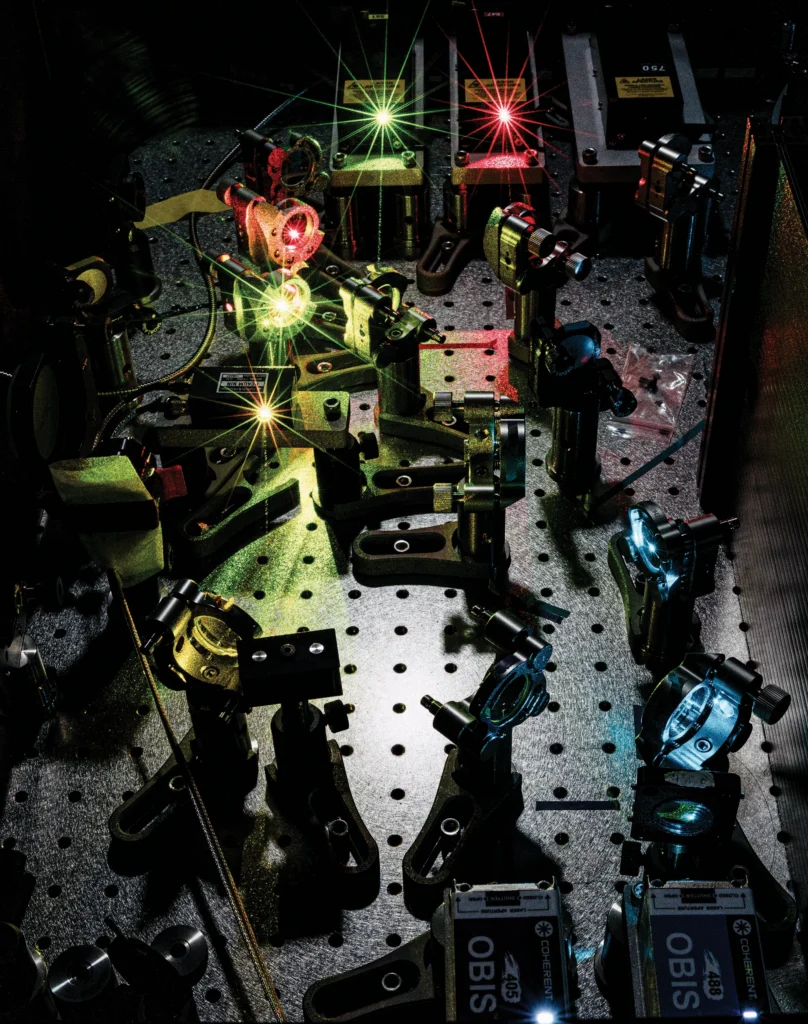
In 2019, his lab developed optical reconstruction of chromatin architecture, or ORCA, to solve that problem. The technique labels DNA segments with unique molecular barcodes, then lights them up one at a time rather than all at once. The result: a colorful thread winding through the nucleus and tracing DNA’s path in 3D space.
The choreography emerges
ORCA showed that genomes’ structures are organized into distinct neighborhoods separated by clear boundaries. Within a neighborhood, DNA sequences frequently bump into each other. But they rarely reach across the boundary to interact with sequences in the adjacent neighborhood. Surprisingly, many of the boundaries were the same between cell types; it was the interactions within each neighborhood that varied.
ORCA also upended another assumption. Some scientists had expected to find “hubs” — enhancers that bind to multiple genes at once. Instead, the data showed something more dynamic: Enhancers rapidly switched between partners, touching one gene, then another, but rarely both simultaneously.
“A lot of the data suggested that these interactions were incredibly transient,” Boettiger said. “We wanted to know more about the timing of that movement.”
In September 2025, Boettiger’s group unveiled their newest tool, called TRACK-IT, which let them watch, in real time, how DNA moved in living cells. Specially engineered fluorescent tags lit up different places in the genome. Boettiger remembers getting it working for the first time: “I was literally singing at my desk,” he recalled.
His lab team saw that within neighborhoods, DNA sequences could find each other in a matter of seconds, regardless of how far apart they sat on the linear chromosome. But at boundaries, everything changed. Search times jumped dramatically, as if the boundaries acted as invisible force fields. The boundaries, they then showed, depended on regions of the genome called insulators that block the formation of DNA loops.
“This kind of work helps us understand the fundamental principles of how a genome works,” Boettiger said. “It gives us a wiring diagram of what areas of the genome can interact with each other, and which can’t.”
The implications ripple beyond basic biology. Understanding how genomes fold could help predict the effects of genetic mutations or explain why some bits of mixed-up DNA cause disease while others don’t. Boettiger wants to create a set of physical rules that help scientists predict how a given strand of DNA will fold — and how that will dictate the function or health of a cell.
“I describe myself as a basic scientist, but I do derive meaning out of the belief that the things we discover will ultimately be useful to society,” Boettiger said.
Spotlight on Alistair Boettiger
Assistant professor of developmental biology
Alistair Boettiger studies how the structure and movement of DNA molecules are linked to gene activity and, ultimately, cells’ identities and behaviors.
- His identical twin brother is an associate professor of environmental science at the University of California, Berkeley.
- His accent is a mix of Philadelphia (where he was born); Manchester, England (where he spent some of his childhood); and Swahili and the Queen’s English (which his mother grew up speaking in Nairobi).
- Advice from his graduate mentor that has most stuck with him: “Be serious about your science but never take yourself too seriously. It’s important to remain humble as a scientist.”
In his words: “I love working on the fundamental questions of how things work and developing new tools that push the field forward.”