Stopping kidney stones at the source
A Stanford Medicine nephrologist is developing drugs that could prevent kidney stones
The pain is often described as worse than childbirth — a searing throb when a hard mineral deposit moves from the kidney into the ureter, blocking urine flow. Kidney stones strike about 1 in 10 people, and for those who develop recurrent stones, life becomes a cycle of intense discomfort, bloody urine, emergency room visits and surgical removals.
“For the patients who keep coming back, there’s not always a good plan for how to prevent the next stone,” said Alan Pao, MD, an associate professor of medicine in the nephrology division. “We can make some tweaks to their diet, and there are some medications that can reduce stones in some patients, but they don’t always eliminate the problem.”
Pao wants to change that. His lab is developing drugs that raise levels of citrate, a chemical naturally found in the urine that can block the formation of some types of kidney stones.
Online extra
Listen to a Health Compass podcast with Alan Pao.
Up to half of all kidney stone patients have unusually low citrate levels, and while a few existing drugs treat the condition, they raise urine pH, which unfortunately can promote a different type of stone. This is particularly problematic for people who have both low citrate and high urine pH — a combination more common in women.
“Most of the time those people are left untreated,” Pao said. “I’m in an environment here at Stanford where I can collaborate with medicinal chemists, cellular physiologists and pharmacologists to come up with new treatments to help these people who don’t have any other options.”
A solution with no side effects
Most kidney stones are made of calcium that combines with other minerals in the urine to form hard deposits. But citrate binds to calcium, preventing that process and keeping the calcium dissolved until it is urinated out harmlessly.
That’s why Pao started focusing on a specific protein, called NaDC1 (sodium dicarboxylate cotransporter 1), that is found in kidney cells. NaDC1 is a transporter — a kind of molecular pump — that pulls citrate from the urine back into the kidneys. When NaDC1 is too active, it reabsorbs too much citrate, leaving calcium in the urine free to form stones. By blocking NaDC1 directly, Pao hopes to increase urinary citrate without raising pH — avoiding the side effects that limit current medications.
Working with the Stanford Innovative Medicines Accelerator, Pao’s team has developed a screening system that can test how well different chemicals block NaDC1.
“My patients have taught me to always think of ways at the bench to help patients by the bedside. My clinical work recharges my basic science work; it reminds me why we do the science.”
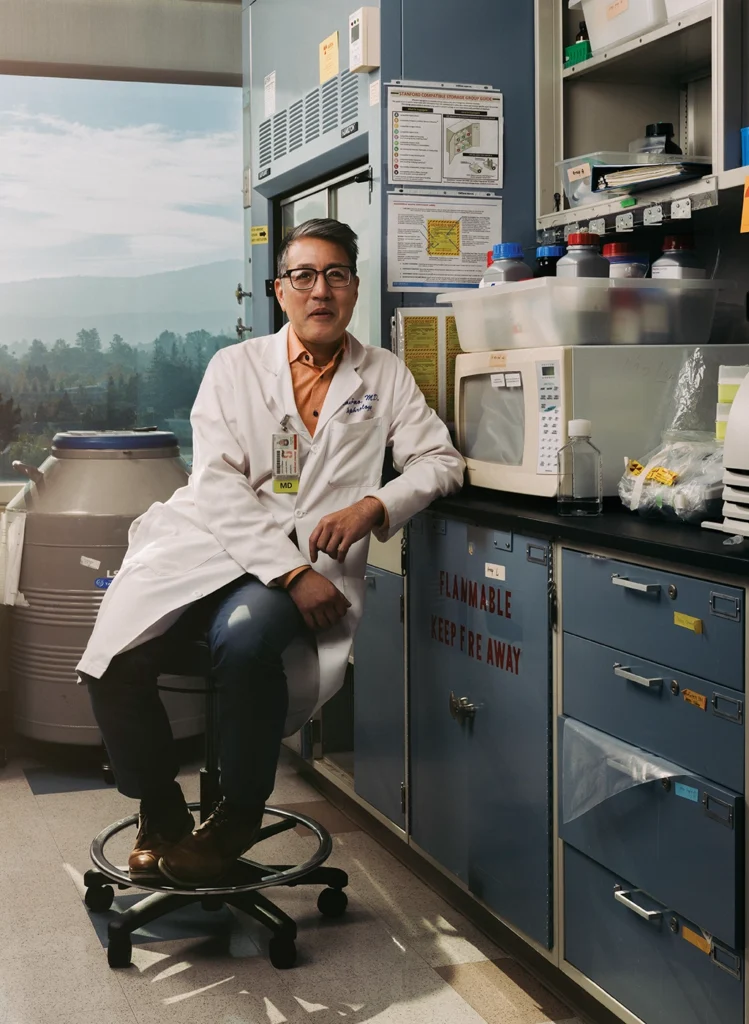
Alan Pao, MD, an associate professor of medicine in the nephrology division
So far, they’ve identified two classes of compounds that work well in lab-grown cells. Next, they must determine whether the drugs can reach the kidneys in living organisms. Working with medicinal chemists, they’re testing derivative compounds in mice to find formulations that make it to the urine while maintaining their inhibitory effects. If successful, the compounds could be patented and tested in clinical trials.
Pao has also launched clinical studies probing how lab tests might give early warning signs in patients with recurrent kidney stones, for instance, and what types of scans are best used in emergency rooms to diagnose kidney stones.
Inspired by his patients
For Pao, the work in his lab is closely intertwined with the patients he sees in clinic, who have often exhausted their options to prevent stones. Some have even donated funds to support the research and regularly check in with him about how it’s advancing.
“My patients have taught me to always think of ways at the bench to help patients by the bedside,” Pao said. “My clinical work recharges my basic science work; it reminds me why we do the science.”
One of those patients is Garrett Farwell, a software sales team member from Menlo Park, California. Two years ago, on his 39th birthday, Farwell ended up in the Stanford Hospital’s emergency department with a kidney stone.
“It was completely unexpected and caught me totally off guard,” Farwell said.
He wanted to do everything he could to prevent another stone but found that he kept getting generic advice: Doctors gave him preprinted information pamphlets without considering his type of stone or individual risk factors.
“When I found out Dr. Pao was doing work that could lead to more precise, personalized and effective kidney stone prevention, I was really inspired,” said Farwell, who has since financially supported the research.
“Those of us who experience kidney stones want to alleviate the constant anxiety of ending up back in urgent care or the emergency room. New drugs like those being developed by Dr. Pao could be life changing with both physical and psychological benefits.”
Spotlight on Alan Pao
Associate professor of nephrology
Alan Pao directs the Stanford Kidney Stone Clinic and runs a research program investigating how doctors can better diagnose, track and treat kidney stone disease.
- Grew up in Chesterfield, Missouri, where he cheered on the “small ball” era St. Louis Cardinals.
- Received his undergraduate degree from Stanford University in 1994 before attending medical school at Washington University in St. Louis.
- Loves to visit art museums around the world. His favorite artists are J.M.W. Turner, Tsukioka Yoshitoshi and Gustav Klimt.
In his words: “It’s incredibly satisfying to be at the forefront of trying to push what’s known in a way that could actually lead directly to new treatments for the patients who need them.”