

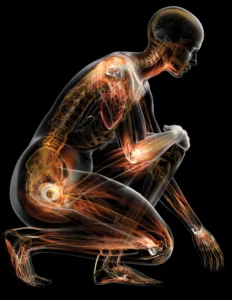
Gut feelings
Untangling the complex connections between the gut, brain and microbiome to heal chronic GI conditions

On Halloween 2021, Brittney Doutt was at her dad’s house, preparing for an evening of fun, when she had a sudden wave of nausea. “Out of nowhere, I was like ‘Oh, I’m going to throw up!’” said Doutt, who is now 30. As her stomach churned, she panicked; she has always had a phobia of vomiting. Doutt drank some ginger ale and went outside for fresh air. Her nausea slowly subsided. “This … is … strange,” she recalled thinking.
If that had been the only episode, she might have dismissed it. Instead, over the next few weeks, more unexplained bouts of queasiness resulted in Doutt feeling ill all the time. “It was just nausea 24/7,” she said. “I couldn’t sit comfortably. The moment I would lie down, it was 10 times worse. At that point I stopped eating because I just could not deal with adding anything new.”
As she struggled to find an explanation, Doutt became part of a group nobody wants to join: patients whose gastrointestinal symptoms resist diagnosis. Doctors might tell these patients something hand-wavy — maybe they have anxiety, or perhaps it’s irritable bowel syndrome — and advise cutting various foods from their diets.
Patients can become mired in vicious cycles: Dietary restrictions drive abnormal shifts in the populations of microbes living in their gastrointestinal tract (their gut) and, thanks to strong neurological links between the gut and the brain, their stress and GI symptoms compound each other.
An interdisciplinary Stanford Medicine team aims to provide people stuck in these cycles with off-ramps. These experts are helping patients reset the connections between their guts and brains while advancing the science of how the gut microbiome influences our health.
“Instead of just the gut-brain interface, what I talk to my patients about is the food-microbiome-immune-gut-brain interface, that ecosystem and how it can become disordered,” said gastroenterologist Sean Spencer, MD, PhD, who sees patients at Stanford Medicine’s Digestive Health Center.
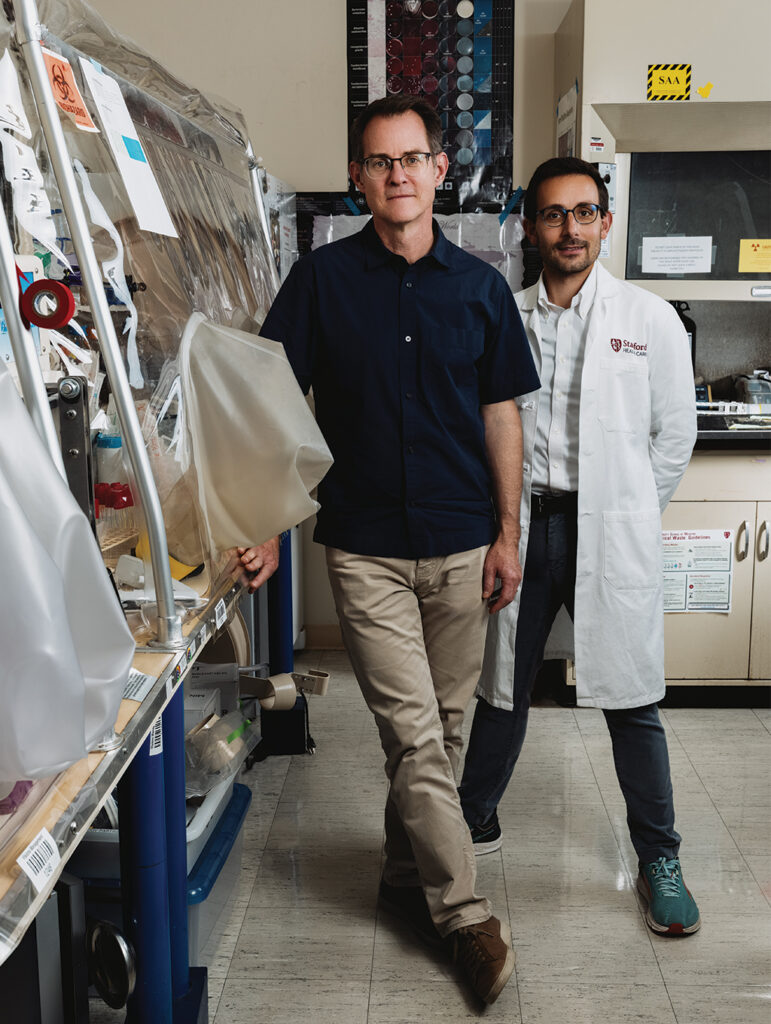
Related content: In a new episode of Stanford Medicine’s Health Compass podcast, Sean Spencer, MD, PhD, an assistant professor of Medicine in gastroenterology and hepatology, explores how food changes the microbiome and our overall health.

Soon after arriving at Stanford Medicine as a fellow in 2017, Spencer recognized that his interests in these overlapping areas could be especially helpful for patients with what are termed “disorders of the gut-brain interface,” often those whose GI symptoms remain unexplained after excluding such diagnoses as celiac disease or lactose intolerance. Patients suffer combinations of nausea, gas, cramping, diarrhea and/or constipation without an obvious cause.
“Their guts and brains are not speaking well together,” Spencer said. “Unless you put a really careful lens onto why they’re having symptoms, they end up afraid of food, with trauma and stress around food and restrictive eating disorders.”
Untangling the many threads of what has gone wrong for these patients requires several kinds of experts to work in concert, he added, with attention to patients’ physical and mental health.
“A lot of this has a root cause of some physiologic process that becomes cognitively amplified times a million, but there’s still an underlying physiology that is perturbed,” Spencer said. “We have to attack it from all angles so we can fix the physiology and address the food-related traumatic stress.”
Finally being heard
Doutt’s initial visits to her primary care doctor didn’t explain what was wrong. A prescription for Zofran, a powerful anti-nausea drug given to cancer patients to help manage side effects of chemo, didn’t solve the problem either. Over a two-month period, she lost a lot of weight and barely slept. Finally, her very worried partner, Kyle Vanden Brand Horninge, helped her connect with Stanford Medicine gastroenterologist Irene Sonu, MD, a clinical associate professor of medicine, who, like Spencer, sees patients at the digestive health center.
The first thing that stood out for Doutt was that Sonu didn’t make assumptions.
“I just ate the same thing every single day. It stayed that way for over a year.”
Patient Brittney Doutt was diagnosed with gastroparesis — slow stomach emptying
“Other doctors didn’t really give me the time of day; they saw that I was crying and distraught and, I think, jumped to, ‘Oh, you have anxiety,’” Doutt said. “Dr. Sonu has been my savior. It was like, somebody who is actually listening to me! This is so comforting!”
After Sonu asked Doutt to describe her symptoms, Sonu ordered a smart pill test. This involves swallowing a capsule of electronics that, as it travels through the digestive tract, collects key information about the patient’s gut, such as the speed of different parts of the journey, as well as pressure, pH and temperature.
Doutt’s test showed that gastroparesis — slow stomach emptying — was the likely cause of her nausea. To help with the condition’s symptoms, Sonu prescribed the drug mirtazapine — not for its typical use as an antidepressant but for its ability to suppress nausea and increase appetite.
The next step was to help Doutt start eating again, a complex task because she had become so wary of food. At first, her list of “safe foods” was tiny: sautéed spinach, mushrooms and egg whites, Hawaiian rolls — a soft, sweetened dinner roll — and coconut water. “I just ate the same thing every single day,” Doutt said. “It stayed that way for over a year.”
Some things can be explained
As challenging as Doutt’s situation was, her gastroparesis could be diagnosed with the right test. Many patients have debilitating GI symptoms that no standard medical test can explain.
They might have visceral hypersensitivity, meaning normal gut physiology and hyperactive nerves. “We don’t know why this hypersensitivity occurs,” Spencer said, adding that scientists suspect a combination of genetic vulnerability and environmental insult. A patient might, for example, take antibiotics for an infection and have lasting symptoms.
Before coming to Stanford Medicine, such patients have often been told they have irritable bowel syndrome. Standard treatment for the syndrome leans heavily on cutting out foods.
“Patients have gone to five GI doctors and every doctor has told them to eliminate something from their diet,” Spencer said. Some have been advised to start the low-FODMAP diet, discontinuing foods that contain fermentable oligosaccharides, disaccharides, monosaccharides and polyols, which may cause GI symptoms in some people.
“Sometimes our bugs change, and then our diet changes, and rather than hugging, they’re fighting. We want to reharmonize the gut.”
Gastroenterologist Sean Spencer
In practical terms, this means patients stop eating wheat, dairy, legumes, and many fruits and vegetables. After a few weeks, they’re advised to work with a dietitian to resume eating foods one at a time so they can pinpoint a few troublemakers to avoid, then return everything else to their diets. But some patients try the first phase of the diet, feel better and never expand what they eat, or have trouble getting access to a dietitian.
In extreme cases, “They say, ‘I’m eating chicken and white rice, and that’s all I can eat. I eat anything else and I get diarrhea, I get abdominal pain,’” Spencer said.
Severe dietary restrictions feed long-term problems — both psychological struggles and biological issues that Stanford Medicine researchers are investigating. The biggest biological problem is that a low-fiber diet banishes key gut microbes, which are difficult to get back.
Spencer is an early adopter of a diagnostic test that helps provide direct evidence of which foods are irritating an individual patient’s intestines. Pioneered in Europe and marketed under the trade name Cellvizio, the test directly images the gut’s response to specific foods. In an endoscopy procedure, the clinician adds a small amount of suspect food to the interior of the intestine, then uses confocal laser endomicroscopy to monitor for inappropriate migration of immune cells and leaking of blood vessels into the intestine.
“It’s a pathophysiologic explanation for a food-induced leaky gut,” Spencer said. The test can give patients a much faster path to a targeted list of foods they should avoid. Spencer hopes this will allow patients to bypass the risks to the gut microbiome that come with very restrictive diets, including low-FODMAP diets.
The mysterious gut-bug landscape
“It’s hard to comprehend the number of bacterial cells in our guts,” said Justin Sonnenburg, PhD, the Alex and Susie Algard Endowed Professor and a professor of microbiology and immunology. His research on gastrointestinal microbiota helped attract Spencer to Stanford. We have more microbes in our guts than human cells in our entire bodies, a fact that prompted Sonnenburg to say, only half-joking, “We are a fancy culturing flask, here to acquire food to feed these microbes.”
In healthy people, gut microbes break down plant fiber that we can’t digest. The bugs’ metabolic byproducts, such as short-chain fatty acids, are absorbed into our blood.
“They look like pharmaceuticals, little drugs, and they behave like drugs. We don’t understand everything they are doing to influence our health, but they end up everywhere,” Sonnenburg said. Studies hint at a variety of benefits from these bacterial byproducts, everything from keeping the immune system in check and lowering obesity and cardiovascular risks to improving bone and brain health. In short, we want these bugs on the job.
Sonnenburg’s team has shown that gut microbes look quite different in people eating typical Western diets than among hunter-gatherer populations, who consume much more fiber.
“If you’re not feeding the microbiome fiber, it starts eating you, consuming the mucus layer and causing inflammation. The adage ‘Good fences make good neighbors’ is true in the gut microbiome.”
Justin Sonnenburg, professor of microbiology and immunology.
As we’ve industrialized and moved away from fiber-heavy ancestral diets, our gut microbes have shifted to use more oxygen and promote inflammatory host responses such as the generation of reactive oxygen species, aka “free radicals,” that could contribute to inappropriate immune responses and chronic disease.
Worse, people with severe GI symptoms might eat so little fiber that their gut microbes starve. Not only are these patients deprived of beneficial bacterial metabolites, but the microbes also damage the mucus lining that normally keeps gut bugs away from the walls of our intestines.
“If you’re not feeding the microbiome fiber, it starts eating you, consuming the mucus layer and causing inflammation,” Sonnenburg said. “The adage ‘Good fences make good neighbors’ is true in the gut microbiome.”
Spencer has another way to describe how we get along with our gut microbes: “In health, we feed our bugs and we have this close relationship; it’s like a hug between us, our diet and our bugs,” he said, knitting his fingers together to show what he means. “Sometimes our bugs change, and then our diet changes, and rather than hugging, they’re fighting. We want to reharmonize the gut.”
He aims to practice restoration ecology for his patients. “I grew up in Wisconsin, where naturalist Aldo Leopold is a big figure because he pioneered the field of restoration ecology by working with nature to restore complex prairie ecosystems,” he said. “It’s kind of like that. The ecosystem is dysfunctional, and we’re trying to reharmonize it. We need to understand which parts we can change. Do we manipulate the immune system? The microbiome? The diet? Ideally, we do it all in combination.”
The gut-brain connection
As Stanford Medicine experts seek to understand the intestinal ecosystem, they are also putting knowledge about the gut-brain connection to work helping patients.
Not long after diagnosing Doutt with gastroparesis, Sonu referred her to other members of the Stanford team, including clinical psychologist Meredith Craven, PhD, who specializes in GI psychology. Craven teaches a class in hypnotherapy techniques that address gut-brain miscommunication, which Doutt took to help her cope with GI symptoms.
They also had individual appointments. In one of them, Craven asked Doutt to describe her relationship with food, a question she poses to every new patient.
“I remember what I said to her: ‘I have always been a foodie. I love food!’” Doutt said. “And I was hating food.”
Before she got sick, Doutt eagerly explored restaurants, flavors and tastes: “Spicy, seafood, raw, I’d try it.” She could be particular — she’d order sauces on the side so she could decide how much she wanted — but approached food with an adventurous spirit. Now that was replaced with fear and frustration.
“I couldn’t stand how every social interaction revolves around food,” she said. “I felt very excluded.”
Doutt’s struggles are common among Craven’s patients, so she recognized that Doutt met diagnostic criteria for avoidant/restrictive food intake disorder, which causes low food intake but isn’t motivated by a desire to lose weight. Instead, patients fear food or the consequences of eating. It’s not unusual for ARFID to develop in the wake of a disorder of the gut-brain interface; one study of more than 900 irritable bowel syndrome patients found that 13% had the eating disorder.
“Patients will say, ‘Oh, see? I’m experiencing GI symptoms; I must not be able to eat this. It can become a self-fulfilling prophecy. The more you’re avoiding food, the scarier it’s going to become.”
Clinical psychologist Meredith Craven, who specializes in GI psychology.
Craven uses cognitive behavioral therapy to help ARFID patients, starting with education about gut-brain communication. Stress — including worry about GI symptoms — arouses the autonomic nervous system, putting a person into a “fight or flight” state.
This, alone, makes the gut churn.
“Patients will say, ‘Oh, see? I’m experiencing GI symptoms; I must not be able to eat this,’” Craven said. “It can become a self-fulfilling prophecy. The more you’re avoiding food, the scarier it’s going to become.”
When she explains these connections to patients, they often have an Aha! moment. “They’re like, ‘That’s me!’” Craven said. “They get a lot of hope. The whole idea is that if we can change one part of this cycle, we can change the rest.”
With that motivation, Craven and her colleagues can guide patients through the next steps, such as the hypnotherapy class Doutt took, as well as exposure planning to help them reintroduce foods. In exposure planning, therapists ask patients to list every food and food-related situation they avoid and rank each one according to how much anxiety it provokes. Then patients pick some foods from the middle of the list — not too intimidating — to try.
At first, Doutt thought, “I don’t want to risk anything! I’m OK, I’m eating the foods on my safe list and that’s how I’m gonna live my life.” But a Stanford dietitian pointed out that her safe list was so small it wasn’t providing adequate nutrition. So Doutt joined an exposure therapy class at Stanford Medicine for a group of people in similar situations, which helped her expand what she was willing to eat.
“One of the days, I picked an avocado, and it was, OK, let’s try one bite, and you talk through what worked for you and what your plan is.” Another day it was three bites, then five. Participants talked about what they were feeling — “I had a little discomfort but it wasn’t extreme,” for example. With repeated exposures, Doutt could tolerate all of the emotions around eating something new.
Foods to heal the microbiome
For patients like Doutt, who are making a journey back to a more varied diet, Spencer and his colleagues encourage gradual reintroduction of fiber-rich foods to provide a foundation for the right bugs to return to their intestines and set up housekeeping. “When people increase their fiber intake, we always say, ‘Go slow and steady; your microbiome will adjust,’” Spencer said. He often suggests oats and sweet potatoes as the best starting points.
Fermented foods, such as yogurt, kimchi, miso paste and sauerkraut could also play important roles in restoring gut health. A Stanford Medicine team led by Sonnenburg; his wife and research partner, Erica Sonnenburg, PhD, a senior scientist; and Christopher Gardner, PhD, the Rehnborg Farquhar Professor and professor of medicine at the Stanford Prevention Research Center, conducted a study published in Cell in 2021 in which healthy people were randomly assigned to eat diets high in fiber or high in fermented foods for 17 weeks.
On the high-fiber diet, improvements in immune profiles were observed mostly in people whose microbiomes were diverse to begin with. But in the group eating fermented foods, more dramatic benefits accrued, including a gain in microbial diversity for all participants and decreased levels of immune markers of inflammation. The research team is now exploring which components of the fermented foods cause these changes, and how they work.
These findings feed into Spencer’s research on more efficient, evidence-based ways to remodel the microbiome. Some patients have microbiomes so out of whack that a diet-only approach might never help, he said: “What I’m envisioning in the future is to identify the dysfunction in a patient’s microbiome and fix it.”
He’d like to be able to offer his patients better probiotics, for one thing. Currently, probiotics for sale at health food stores generally contain mixtures of bacteria similar to those found in yogurt; they don’t match what lives in a healthy person’s intestines. They are not designed to degrade fiber or integrate into the intestinal ecosystem.
To bridge the gap, a Stanford Medicine project, the Microbiome Therapies Initiative, led by Michael Fischbach, PhD, the Liu (Liao) Family Professor and professor of bioengineering, is identifying the right microbes and testing how to give them to people. Working with Spencer, the initiative’s members are developing a combination of bacteria to give to patients with IBS based on previous work published in Cell in 2022.
“What I’m envisioning in the future is to identify the dysfunction in a patient’s microbiome and fix it.”
Sean Spencer
During his time at Stanford, Spencer, with a diverse set of collaborators, has catalogued gut microbes at different locations along the 20-foot length of the small intestine. (Traditionally, assessments have been done only on the microbes present in poop, which offers a limited window to the digestive ecosystem.) They have collected microbes from locations along the intestines of deceased organ donors, as described in a study published in Science in 2022.
In addition, the scientists devised a method to sample what grows in different locations along the intestine in living people. In one study, researchers gave healthy volunteers sets of four capsules to swallow. Each capsule had a coating that dissolved at a different pH or time, corresponding to a different region of the intestine.
When the coating dissolved, a one-way valve was exposed, allowing the capsule to capture intestinal fluid. After the capsules were excreted, the researchers analyzed the contents to catalog which types of bacteria, phages (which are viruses that attack bacteria), human proteins and bacterial metabolites predominated in each intestinal region. They also measured bile acids — digestive acids produced by the liver and secreted into the intestine during digestion — and assessed how bacteria in different intestinal locations had modified the bile acids there.
The study found that, while fecal bacteria were fairly similar in everyone, small intestinal ecosystems had more variation between different healthy individuals. The findings, published in 2023 in Nature, laid groundwork for studies to understand how the microbiome changes in disease. The research was led by David Relman, MD, the Thomas C. and Joan M. Merigan Professor and a professor of microbiology and immunology, and KC Huang, PhD, a professor of bioengineering and of microbiology and immunology.
Researchers also have early data showing that a few bad players might have taken over the microbiome of some people with digestive problems, so instead of fiber breaking down normally, the bacteria cause symptoms such as bloating or diarrhea.
The next steps are to figure out which bacteria from each gut locale are most important to restore and whether it’s possible to do that with a “next generation” of probiotic supplements designed to improve microbiome health. “It’s a dream right now, but all the pieces are present,” Spencer said.
A foodie again
Today, Doutt is past her miserable months of nausea. She’s eating well, is still adding foods to her diet, and her ARFID is in remission. She has a toolbox of strategies to use when her symptoms flare, including the techniques she learned in the hypnosis class and occasional doses of Zofran. She has returned to social activities like dining in restaurants and enjoying holiday meals with her family.
She also has a deeper sense of gratitude for her partner, who has been steadily supportive. One Stanford psychologist long ago told Doutt that people who are struggling don’t always want answers and directives; sometimes they just want someone to “sit in the puddle with them.”
“I’m very lucky to have my partner, because he sat in the puddle with me for a very long time,” Doutt said. She and Vanden Brand Horninge recently took a two-week trip to Ireland, London and the Netherlands, something she could not have imagined a few years ago. Although Doutt felt trepidation about eating away from home, she loved the “cozy weather food” in Ireland — mashed potatoes, gravy, comforting desserts. In the Netherlands, her partner, who is Dutch-Indonesian, wanted them to try some of the country’s Indonesian food.
“It was really good, but definitely a little spicy, and that upset my stomach,” Doutt said. “I was like, OK, I’m going to take a Zofran, I haven’t taken one in a while, and I’m going to walk it off. I have things to distract me. It’ll be fine.”
It’s a good example of how her strategies for handling symptoms have helped move food to a healthier position in her life. She once again considers herself a foodie, with caveats.
“I love food, but sometimes food doesn’t love me. That’s how I see it,” she said. “And I don’t know if I want to say that I’m thankful for it, but I think I have a better understanding of my body and truly who I am, mentally and physically. That has been really nice.”
When food becomes the enemy
About avoidant/restrictive food intake disorder
Gut conditions tend to cause anxiety about eating — and that anxiety can be extreme, leading sufferers to develop a condition known as avoidant/restrictive food intake disorder, or ARFID. Though ARFID was designated as a new eating disorder in 2013, it’s not yet widely recognized or understood. Fortunately, effective treatments are available. Here are some other facts about the condition:
• In avoidant-restrictive food intake disorder, patients don’t eat enough. They can experience malnutrition.
• Patients are not trying to lose weight, nor are they worried about body image.
• ARFID patients experience sensory aversions to food or are afraid of possible consequences of eating, such as choking or nausea. They may have little or no appetite.
• The condition is most common in kids, including children with autism or attention deficit hyperactivity disorder, but it can develop in anyone, at any age. It affects more than 10% of people with disorders of the gut-brain interface.
• ARFID isn’t the same as picky eating, which does not interfere with getting enough nutrients and often resolves on its own. ARFID needs treatment.
• Treatment includes cognitive behavioral therapy, starting with helping patients identify motivations for change. Treatment also helps them understand how their thoughts and behaviors concerning eating may harm their health.
• As part of treatment, patients may list foods they avoid, then slowly reintroduce them during planned exposures. They practice building tolerance to sensory and emotional challenges as they eat, with guidance from a therapist or doctor.
