In sight
New approaches to glaucoma, the leading cause of blindness
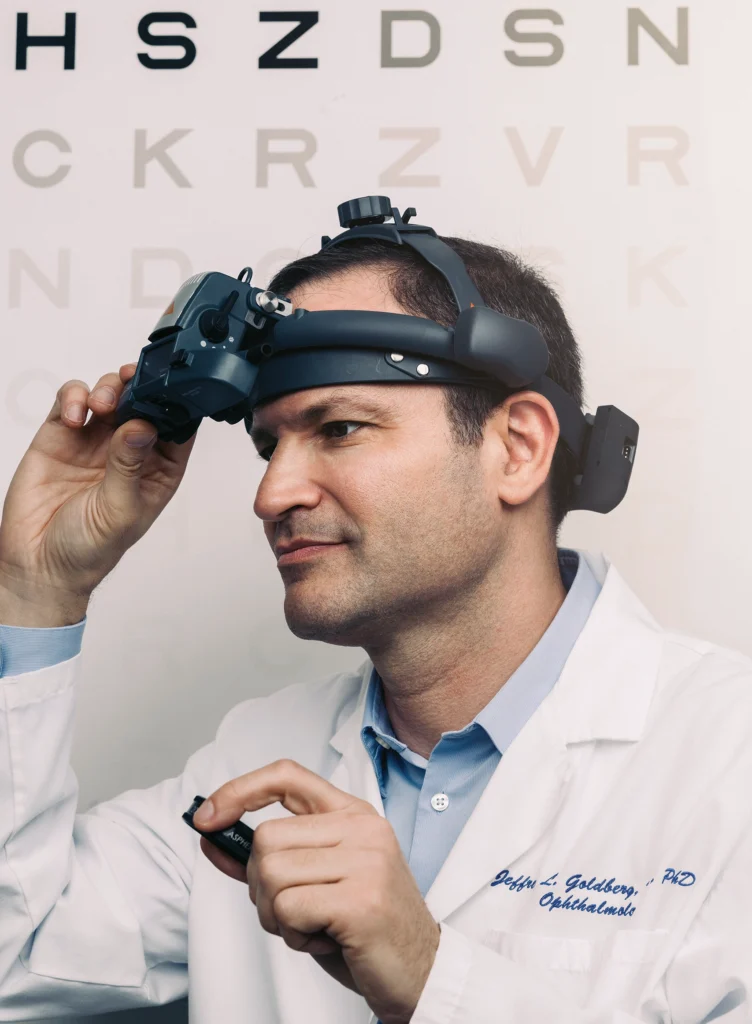
It sounds like something out of science fiction: an implant for the eye packed with genetically engineered cells that could restore vision to the blind. But Stanford Medicine’s Jeffrey Goldberg, MD, PhD, is testing this and other innovative therapies in patients with vision problems and is finding promising initial results.
Goldberg, the Blumenkranz Smead Professor and chair of ophthalmology, studies glaucoma, the leading cause of irreversible vision loss and blindness, and related problems. Glaucoma damages the optic nerve, the bundle of fibers called axons that transmits all visual information from the eye to the brain.
Glaucoma treatments generally focus on reducing abnormal pressure in the eye. If you have annual eye exams, you’ve likely had your eye pressure checked with, for example, an instrument with a glowing blue light that rests on the surface of your eye.
Online extra
Listen to a Health Compass podcast with Jeffrey Goldberg.
Elevated eye pressure is a risk factor for glaucoma, and reducing that pressure through laser treatments, medicated eye drops or surgery can slow the condition’s progression. But no treatments exist to fully stop this progression or to repair or rejuvenate the damaged nerve.
While existing treatments can slow or halt vision loss, especially if the disease is caught early, they don’t work for everyone — up to 10% of people with glaucoma become resistant to the treatments. And vision lost to glaucoma is lost forever.
“Even among patients with great access to care, a significant fraction of them will progress to legal blindness despite our best treatments,” Goldberg said. “So, there’s a significant unmet need.”
Goldberg and his colleagues hope to change that. For most of his career, no one was trying to advance treatments outside of pressure control for glaucoma. But there has been a recent shift toward developing and testing new forms of therapy, he said.
“Over the last 10 years, we’ve been pushing wherever we can to take advances out of the laboratory and into human trials,” Goldberg said. Advances Goldberg studies include experimental therapies in the realm of neuroprotection, which prevent further degeneration of the optic nerve, and neuroenhancement or neurorecovery, where treatment restores damaged nerve cells. “This could actually even improve patients’ vision,” he said.
One such therapy is an implant filled with stem cells that secrete a hormone known as a growth factor, called ciliary neurotrophic factor, or CNTF. CNTF is found naturally in the eye and brain and helps support the growth of new neurons. Goldberg and his laboratory used it in preclinical animal studies of glaucoma, then partnered with a biotech company to test the implant device in patients with the eye condition.
The company had developed the device for a different, rare vision condition but Goldberg realized, based on studies of CNTF, that it might work in glaucoma, too. The tiny dumbbell-shaped implant, a bit more than half a centimeter long and a millimeter wide, is surgically placed in the eye’s vitreous cavity, the gel-filled space in the eyeball between the lens and the retina.
A permeable membrane on the implant allows the release of CNTF secreted by the implant’s stem cells, while also keeping the cells sequestered from the patient’s eye. Goldberg’s team recently completed a multicenter, randomized, Phase 2 clinical trial of the device and saw strong neuroprotective effects: The implant prevented severe vision loss caused by glaucoma, although in this smaller trial it did not seem to reverse vision loss.
Exploring glaucoma’s mechanisms
In other trials, Goldberg’s team at Stanford Medicine is testing treatments that include electrical stimulation of the retina and growth factors delivered by eye drop.
“Jeff is a world-recognized authority on neuroprotection to detect and prevent vision loss from glaucoma,” said Thomas Brunner, president and CEO of the Glaucoma Research Foundation, which has supported some of Goldberg’s research. “His research on protecting and even replacing the retinal nerve cells that connect the eye to the brain could be a major breakthrough and effectively cure glaucoma.”
In his lab, Goldberg studies what causes glaucoma and related eye diseases that lead to optic nerve damage. Interestingly, the damage is associated with high eye pressure but is not directly caused by physical forces of that pressure. Rather, increased pressure triggers molecular and cellular changes that cause nerve damage and neuron death.
Last year, Goldberg and his lab team discovered something interesting about cells known as astrocytes. While neurons convey information from the eye to the brain, “support cells” such as astrocytes influence how these neurons function. The team found that astrocytes can speed or slow glaucoma’s progression, depending on how they react to the disease, and in a study in mice they uncovered a beneficial population of astrocytes that suppress the damaging astrocytes.
They also developed a gene therapy that, when delivered to the animals’ eyes, flips the astrocytes from harmful to helpful, thereby preventing nerve damage, according to a 2024 study in Nature.
Goldberg said he sees gene therapies and growth factor treatments as additions to current treatments. “It would be like a belt-and-suspenders approach. One day our patients will have their eye pressure-lowering therapy and also their neuroprotective or regenerative therapy.”
— To learn more about Goldberg’s open clinical trials, click the “Glaucoma” tab at stan.md/GlaucomaTrials.
Spotlight on Jeffrey Goldberg
Chair of ophthalmology
Jeffrey Goldberg develops and tests innovative ways to overcome nerve damage caused by glaucoma, the world’s leading cause of blindness. In the more than 20 years he has studied glaucoma, Goldberg said, this is the first time the possibility of more effectively preventing vision loss, or even restoring lost vision, seems to be within reach.
- Enjoys hiking and biking around the Bay Area with his wife and children.
- Earned both his doctoral degree in neuroscience and his medical degree at Stanford Medicine.
- Squeezes in a daily crossword puzzle.
In his words:“As a clinician-scientist seeing patients, I am very motivated by the burden of these diseases. These are real people with real families and real lives we are trying to help.”