

A second chance
Mysteries of life and cancer treatments

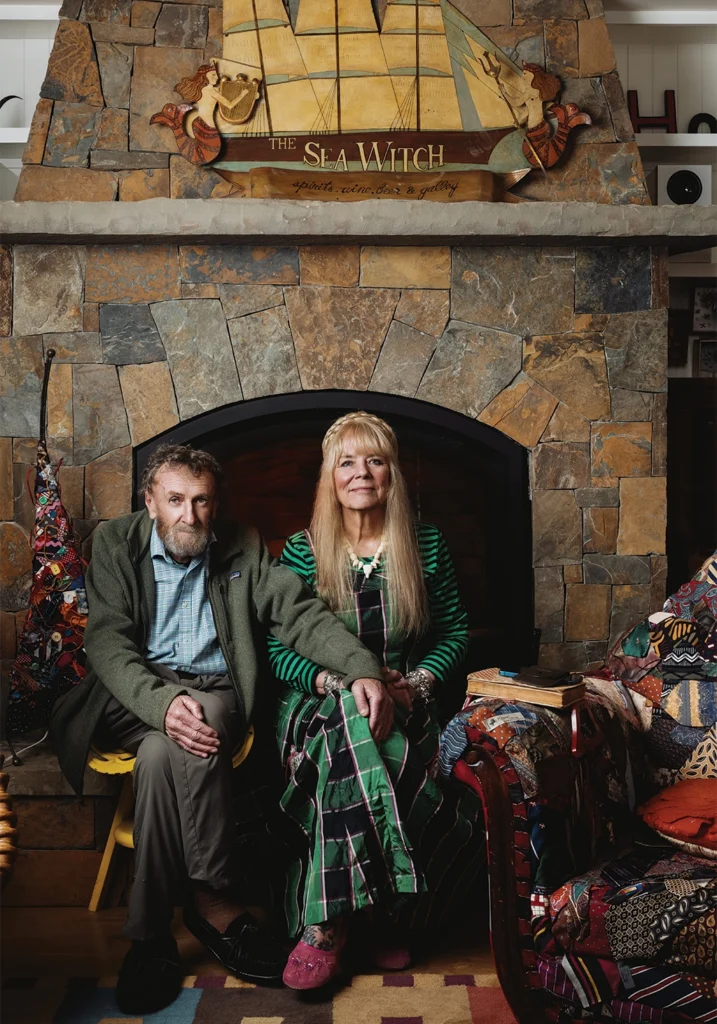
It was a year of waiting, a devil’s bargain with the weekly poison of chemo that was keeping my husband alive yet destroying him. Jabbing us with its sharp elbows, this brutal cancer had come to live with us nearly 10 years ago. Mike had already cycled through five different chemo medicines. This was the last one. What’s going to happen when the chemo no longer works?” I wondered every day. It was a question I never spoke aloud. It is hard to live without a horizon — without an idea of a future.
And Mike, he looked like a giant question mark. Bones eaten by the cancer, his head falling forward from the weak, rounded curve of his spine. So skinny he was almost two-dimensional.
Each day I asked myself if it would be the last time I hear him speak my name, the last time we hold hands. Would I ever hear him say again, “I love you”?
Time was sanding us down in its relentless, impersonal caress. Days never punctuated by hope. Stillness rippled only by the sound of my breathing, the slap of my footsteps across our wooden floor, my occasional whispers of Mike’s name.
Though quiet, I was manic. I was supposed to be finishing my third novel, but like Jack Nicholson in The Shining, I ended up writing the same chapter over and over again.
Hoping to kindle joy, surprise, I looked through old books, read poems I once loved, but all those words I used to love just wilted in my hands like a bouquet of wildflowers clutched too long.
Weeks stretched into a month, another month and then a whole summer. Finally came the word we had been dreading.
“Hospice,” his doctor said one day in a video call.
Here it was. No deal with God, no political strategy, no wily campaign: We could not outthink this one.
Except maybe, just maybe, we would.
The bald-headed alien
“What is the latest approach to multiple myeloma?” I typed into Safari search late one night. A strange new phrase floated out of the digital hemisphere. CAR-T, approved by the FDA only the previous summer. I clicked on the link.
It looked like a drawing done by a third grader, a picture of what looked like a bald alien, surrounded by blue bubbles of information. Bubble one: Remove blood from patient to get T cells. Bubble two: Make CAR-T cells in lab. Bubble three: Grow millions of CAR-T cells. Bubble four: Infuse CAR-T cells back into patient. Finally, bubble five: CAR-T cells bind to the cancer cells and kill them.
Wow. Could a bald-headed alien be our savior? It sounded like an Old Western shoot ’em up.
Even its name, CAR-T, seemed whimsical. Though I now know its pronunciation is “car” followed by “tee,” I first read the term as “cart” and it reminded me of a scene in The Wind in the Willows, my favorite children’s book. In that tale, Mr. Toad builds a rolling Roma home, a swaying cart pulled by an old horse, wheels painted bright red and blue, shelves ingeniously folding out to become a table and bed, even a canary cage with a live canary.
At the end of the chapter, however, a car comes down the road, the horse rears up and the cart overturns. No one is hurt — and the toad, now completely enraptured with automobiles, sits in the middle of the road and watches the car disappear.
Time seems malicious, immutable. New daffodils push their golden heads up through the dirt, but each bloom reminds me only that Mike’s cancer cells are multiplying.
We asked Mike’s oncologist to transfer his case to Stanford because they were on the cutting edge of this new approach. Again we waited, this time to be approved for this innovative procedure.
911, and suddenly Mike was in the hospital fighting for his life. His spine, grown weak from multiple myeloma, was laced with holes. Then a problem with a twisted bowel. After his release he was so weak he could not even sit up in bed, so we decided he should stay with a caregiver friend, Tenzin, who is a devout Buddhist.
For months, Tenzin worked with Mike; his daily administration of care was his own particular form of prayer. Exhaling great clouds of warmth and comfort, every day Tenzin brought Mike plates of delicious food. But he refused to eat. New hollows in his cheeks, he had lost nearly 50 pounds and, as his spine collapsed, nearly 6 inches of height.
But Tenzin kept at it. First, he persuaded Mike to sit up in bed and later to walk with a walker, then a cane. Eventually, Mike walked by himself.
And then Mike is back home, but still we are waiting for approval. Winter 2023 turns into spring 2024. Time seems malicious, immutable. New daffodils push their golden heads up through the dirt, but each bloom reminds me only that Mike’s cancer cells are multiplying.
Where ghosts still speak
Mike is from a spit of land in southern Ireland, a thin peninsula sticking out into the Atlantic. If the beauty of Leonard Cohen’s “Hallelujah” could be translated into geography, Sheeps Head would be it.
In Mike’s early years there was no electricity. His mother cooked the family’s meals on a peat fire, people worked the fields with horses.
While walking the spine of Seefin Mountain, one can read the temperaments of Mike’s parents in the terrain. His mother is from the wild and beautiful north, as impassioned as that landscape. Deep crevices, pounding surf, the north is a place puckered with loss, fermented secrets, wild urges. The wind, harsh with history’s breath, reminds anyone who ventures forth that they are superfluous. The north’s Priest Rock is where people went to pray in secret during the British occupation.
Mike’s father came from the south side. The land, a fastidious log of used days, seasons, used lives, is arithmetic perfect, quilted with geometric squares, stone houses, long rock walls that run down to Dunmanus Bay. A little stern, Mike’s father did not speak much. He worked hard his whole life and was renowned for his judicious fairness, legislating neighbors’ quarrels.
Present-day Sheeps Head is a place of origins where the past and its history are always close by. On Sundays, the descendants of Mike’s paternal grandparents, now dispersed like seeds on the wind to Australia and the United States, join a Zoom call to hear from Mike’s brother James, a local historian, about the distant relatives who began them.
Time folded so many times, it’s almost as if ghosts have joined their conversation — they rock in rocking chairs, light their pipes, extract an old watch from a vest pocket. A joke first spoken 50 years ago can be resurrected at any moment, evoking fresh laughter.
There’s another meaning of CAR-T — not as whimsical as The Wind in the Willows yet a similar but heartbreaking storyline. Before Mike was born, his 12-year-old sister Mary was steering a horse and cart down a road with a few of her little brothers in the back when the first car to drive through Sheeps Head approached. The horse reared; the cart fell over; and Freddie, Mike’s older brother, hit his head on a rock and died. Mary carried his body across the pasture to her mother. A year later, her mother, then 46, gave birth to Mike. A miracle child, incubated in loss and a mother’s grief, Mike was adored by his family, eventually growing up to become a thoughtful man, exquisitely attuned to sorrow and comfort.
Though Mike arrived in America with only a few shillings, using both his father’s business acumen and his mother’s generous capacity for friendship, he created a prosperous business. He sired three biological kids, adopted another, became a stepfather. As though loving itself is a conscious, tender act, Mike consistently remained a kind, unselfish man even through the rigors of fighting cancer.
Meeting Mike’s doctor
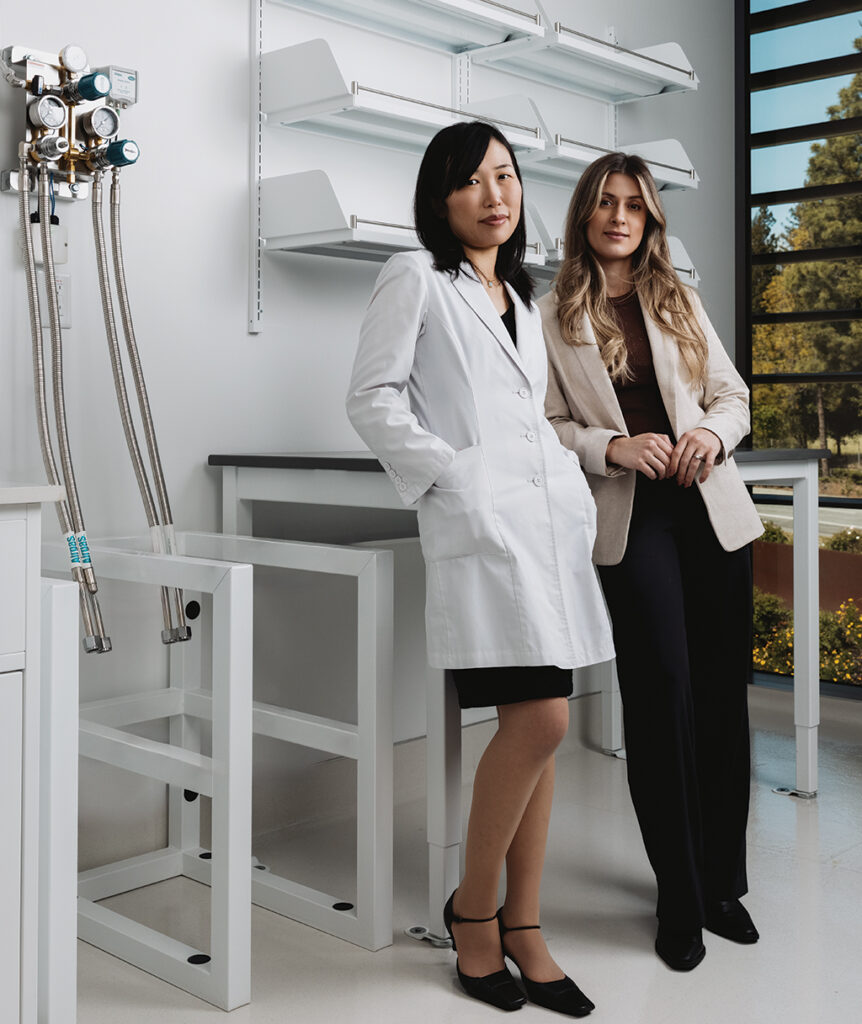
Once Mike is approved for the procedure, we travel to Palo Alto to meet his doctor, Hitomi Hosoya, and her nurse coordinator, Jennifer Rocha.
Dr. Hosoya, who comes from a family of doctors, has both a medical degree and a PhD in cancer work and seems comfortable, even excited, to be living with the mystery at the outer stratosphere of medical knowledge. Meeting Ms. Rocha and Dr. Hosoya, I am reminded that certain people can quickly become a kind of home, though not in a sense of four walls, a foundation and a roof, of course. It’s more that these rare people give you an inside place to rest; for the moment you feel safe.
In the months during and after the procedure, Dr. Hosoya quickly becomes Hitomi and Ms. Rocha becomes Jennifer, eventually morphing into the deeply affectionate “Jenn.”
Like those bubbles surrounding the bald-headed alien, Hitomi describes how Mike’s cells will be extracted in a blood draw and sent to a lab where they will be militarized to attack his cancer. Three days of intensive chemo will kill everything off and make more room for the new cells, and then those upgraded replacements will be deployed into Mike’s body.
Hitomi warns us of the potential for severe medical responses. About a week after infusion, she tells us, when the cells hit full strength, Mike will need to stay in the hospital for at least a week — or more if he has a bad response. After his release he must remain near the hospital for about 30 days of constant monitoring.
The charts and graphs Hitomi shows us are like sacred portals into the articulation of what makes life. CAR-T cell therapy is called living medicine, she tells us. We carry our history in our cells, and that often determines how we respond to disease. She tells us that by the time Mike is treated, she will have performed only 40 of these procedures and, because it is so new, not a lot of information is available about how people will respond beyond three years. Though we understand the science behind CAR-T, she states, we still do not know exactly how it works.
Getting ready
After our meeting with Hitomi and Jenn, we return home to prepare for at least six weeks in Palo Alto. Because we live in Point Reyes, hours away from Stanford, we rent an Airbnb and get a house sitter and a dog walker. Mike updates his will.
Though he is a semi-lapsed Catholic, to fortify Mike for the fight ahead, I ask his sister Dympna in Ireland to look for their mother’s rosary. She hunts for weeks, eventually finding it in an old purse, wedged behind a wardrobe. I imagine the moment she opens it, uncoupling the antique clasp, the rusty sigh as the purse unhinges its jaws for the first time in 40 years.
Within the purse, Dympna found some medals for Saint Teresa, tied with a turquoise thread. The rosary was inside a modest pouch, and “My Rosary” was inscribed on it in formal, slanted type. The purse also held a frayed letter from Mike from when he lived in Alaska and an old photograph, washed in the brown sepia of time. Her head raised, Mike’s mother looks as if she has just spoken. His father stands next to her wearing a hat, his face in the shadow. Mike, a teenager wearing a lumpy homemade sweater, is obviously laughing, his elf ears turned outward as though listening for the next joke.
As I watch him run his hands across the beads, I find myself wondering if a collection of long-lost items now clustered on a bed in California could still whisper a living prayer of hope and love into a son’s ear, 40 years after it was last spoken.
Dympna mails these items to us, and I give them to Mike the night before we go to Stanford for the treatment. He opens the package, spreads everything on the bed, then extracts the rosary’s plastic beads and small silver cross from the pouch.
As I watch him run his hands across the beads, I find myself wondering if a collection of long-lost items now clustered on a bed in California could still whisper a living prayer of hope and love into a son’s ear, 40 years after it was last spoken.
Mike doesn’t say anything, but as I watch his eyes well with tears, I know it has happened: His mother’s last supplication for her beloved son has joined him in the fight for his life, each bead of the rosary charged with the edict, “survive.”
Cells going in
Now the day is here. We crowd into a small room with doctors and nurses, all wearing blue latex gloves, white gowns and masks. Mike lies prone in a recliner, a blanket over his knees. “We’re defrosting his cells,” a doctor tells us, pointing to a Styrofoam box.
“Kind of like defrosting a TV dinner,” I joke nervously. A few polite chuckles.
Fierce protocol is observed. They check Mike’s electrolytes, kidney functions, everything checked twice. One of those blue-gloved hands points to his name. “Is this you?” Mike raises his glasses and squints. “Yes,” he replies. “What is your date of birth?” He tells them. Someone else types his reply into the computer.
Mike asks a pretty nurse how her day is going, and I text the kids, “I think he’s flirting!”
It’s like a sci-fi movie. The lid of the Styrofoam box is lifted, a hiss of smokelike vapor released. Mike’s bag of cells is extracted and hung on an apparatus near his chair. Filled with the ruby-red harvested cells, it looks for all the world like a beaded evening purse. The familiar thump by one of those blue hands trying to find a vein and I wonder if the nurse notices the mementos of a life that are doodled on Mike’s body — a bite mark from a donkey, one index finger marred with rings from when he dropped a herring net too soon and it squeezed his fingers as the boat sped away.
A jab of a needle and the IV line is connected into Mike’s left arm. At first I try to pay attention to everything; watching blood carrying his reprogrammed DNA travel down the long tube and enter his body. It is eerie and ordinary and wondrous all at the same time. Would his newly militarized army of cells march in and annihilate the enemy?
Thinking it might comfort him, I look for a Gaelic lullaby, eventually arriving on a singer dressed in a black cape, thick red hair tumbling down her back. Rough and sweet, her voice moves up through the cold mechanics of the iPad speaker, seeming to lift and spread into the sky, each round vowel filled with hope and beauty.
Trying to honor the sacred in my own maudlin way, I begin to hum “Amazing Grace,” one of my favorite songs.
Is it because I am so off key? Mike asks me to look for something to listen to on YouTube. Thinking it might comfort him, I look for a Gaelic lullaby, eventually arriving on a singer dressed in a black cape, thick red hair tumbling down her back. Rough and sweet, her voice moves up through the cold mechanics of the iPad speaker, seeming to lift and spread into the sky, each round vowel filled with hope and beauty.
I place the iPad before Mike on a tray. His eyes close, and I wonder if he is sailing back home on the breath of the woman’s song.
Maybe this is a song his mother used to sing. Maybe he is once again a 9-year-old boy on a man’s errand, walking up Seefin Mountain with his dog Shep looking for his family’s cattle. Or maybe the song has him traveling even further back into Ireland’s ancient bog, the peat that holds all that has ever lived, all pursuits, all time, along with the carcasses of animals, the roots of old trees, stones, shells and long-ago germination.
Watching Mike’s face soften, the song seems like an aerial explanation of the principle behind CAR-T cell therapy. Living medicine. Like the ancient Gaelic lullaby filling the sterile hospital room, our cells float through eternity like messages in a bottle, carrying both our past and our future.
When the song ends, Mike opens his eyes and speaks quietly, almost to himself. “This is big,” he says, closing his eyes again and falling asleep. His mother’s rosary slips from his hands.
Six minutes. That’s how long the infusion takes. The question is, after nearly 10 years of pain, would all of these new cells, deputized by Gaelic song, be his cure?
The Airbnb
Now comes a period of watching. We are staying near the hospital with our friend Dora. After the procedure, we were given long lists of instructions and told to return immediately if Mike gets a fever or any bad neurological reactions.
The symptoms could start after only four days. He could lose his voice, begin shaking, become confused, even start to hallucinate. Dora and I test his cognitive clarity every morning and night. “What is your name?” we ask. “Who is the president?” We keep charts on the refrigerator of everything he eats and drinks and monitor his temperature around the clock. We give him a pot to bang on if he needs us in the middle of the night.
It is as if Mike is a pioneer homesteading the land of hope for us all. Recognizing that this treatment is both dangerous and innovative, family and friends cheer him on. “Go T cells,” they text day after day.
As his cells multiply and rage, Mike grows restless. His body churns with ceaseless movement. When he is awake, he never seems comfortable, an unending chorus of throat clearing, body spasming. He seems to be speaking more slowly as well, no longer releasing words longer than a couple of syllables. A hard look comes into his face; he is slow to respond to questions, stares at me as though he doesn’t know me.
Where is he? It is as though someone else has stepped into his skin. This new emotionless person still answering to the name of Mike is at once someone I know and a stranger. “Mike,” I say, covering his legs with a blanket. “Come back to me.” Maybe, just maybe, the lab had forgotten to program our love.
It is as if Mike is a pioneer homesteading the land of hope for us all. Recognizing that this treatment is both dangerous and innovative, family and friends cheer him on. “Go T cells,” they text day after day.
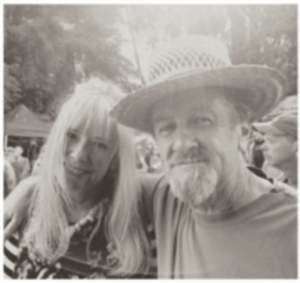
He has never looked so old, never been this new. I like it best when he is asleep. I sneak into his bed, try to rhyme my breath with his. In a photo I have from that time, we are holding hands, the cuff of his flannel shirt, my hippie jewelry, a pirate’s haul of silver.
We have to return to the hospital every day for blood work. I ask a doctor about this new Mike. “In all my years I’ve rarely seen him so shut down,” I tell her. She tells me he’s adjusting to his new cells, reminds me that they don’t understand everything that happens with CAR-T cell therapy.
Not exactly comforting. The wonder and humility that charmed me at the beginning of the process now frighten me. I want guarantees, want to cheat and jump to the end of the book, read the conclusion.
I begin to hate suburbia’s vapid uniformity, the ranch houses, chemical-fed lawns, kitchen decor from Target, ugly paintings of gold and black circles in our rental, chosen just because they matched the upholstery. The unfaltering blandness masks the violence we are living, the war rippling under Mike’s skin. No drones, no guns, but beneath the surface his body is exploding with interior land mines, a paradigm both political and medical I still have trouble with: that waging war can make peace.
It is a strange kind of hypervigilance, staying attuned to danger but trying to turn off thought, every day a circular rhythm, packing Mike into the car, plugging in the GPS, dropping him off at the hospital, driving to the parking lot and taking a photograph of the number slot so I won’t forget where I parked. Kindness begins to matter, conversations in the shuttle driving to the hospital, the big woven blooms on the wall hangings, even the sentimental piano music becomes a coded language for hope.
Hospital
The 2024 solar eclipse is happening the day Mike is scheduled to check into the hospital. His room is bright, filled with clucking, beeping instruments. Teams of doctors and nurses pass through. After weeks of an invisible miracle, I want to see an exterior miracle, want to watch the moon eat the sun the way Mike’s new cells are eating his cancer. Hoping to record the eclipse, I place my iPhone on a small ledge and push the button. Maybe I have the time wrong; the sky above the hospital remains its singular blue.
Mike is prodded awake every four hours. A board is posted outside with the names of about 20 patients undergoing CAR-T cell therapy, a rash of red circles indicating the patients in the intensive care unit, about four or five calm green spots of patients who are not acute.
We are lucky. Mike remains a calm, green spot on that board and is released after only seven days in the hospital. A few more weeks at the rental, visiting the hospital every day for blood work, and then, finally, we are authorized to go home. We head back north where the air smells like the sea; the dark, almost breathing night is filled with silence and old stars; and our beloved dog waits for us. I text the dozens and dozens of people who have regularly checked on Mike’s progress. “Mike’s doing great! Bone biopsy in a month will tell us if this worked.”
Home again
Mike is so loved. Though he is too immunocompromised to meet face to face with people, all the people who have been with us every step of the way — our five kids, relatives in Ireland, friends and business colleagues — call to congratulate him. With bated breath we all wait for the biopsy results.
When Hitomi calls, her professional doctor’s voice is spun with all the colors of the aurora borealis. “We got the results,” she reports. “It’s good. No multiple myeloma showed up. The procedure has worked.”
We have been given a second chance.
How do you resume life when the world is new, everything formerly prosaic, suddenly enhanced. How do you say “thank you” with the rest of your life? I think of poet Mary Oliver’s quote, “What is it you plan to do with your one wild and precious life,” and ask myself every day, “What do I plan to do with my second wild and precious life?”
As if newly appreciating life’s different stanzas, Mike is different these days, more quiet, easily relaxing into spaces filled just with his own thoughts, his own memories … just being. Maybe this shiny sliver of time is what mystics live. Eternal gratefulness.
I think of poet Mary Oliver’s quote, “What is it you plan to do with your one wild and precious life,” and ask myself every day, “What do I plan to do with my second wild and precious life?”
I know I will feel that fear again. Our time here is only a brief fleeting now, a slight comma punctuating history’s long sentence. Bones, cells and blood stitched together with the fine, gossamer thread of DNA, we are all mortal, traveling toward endings.
As I stumble through my days, I try to understand the lessons learned in the past few months. Are there any accidents, I wonder? All those cells, those thousands of tiny vessels pushed up through time by the ghost hands of the dead … do they dictate the recipe of us? Are even these words programmed into the genome of me?
It’s a truth too elusive, too large to hold onto for long and, anyway, all I want to do is resume the ordinary. Birds, the night sky, family and friends, love, the taste of food, the grit of sand beneath my feet.
And Mike. Always Mike.
—
Jeanie Kortum is an author, journalist and humanitarian. She partnered with the National Park System to found the nonprofit A Home Away from Homelessness and has authored the novels Ghost Vision (Random House/Sierra Club) and Stones (She Writes Press/UnCut Voices). She lives with her husband, Michael O’Mahony, in Marin County, California. Contact her at medmag@stanford.edu.
Hitomi Hosoya, a former instructor in Stanford Medicine’s division of blood and marrow transplantation and cellular therapy, is now at Cedars-Sinai Medical Center.
Jennifer Rocha, a former Stanford Health Care nurse, is now at UCSF Health.