The living framework
Inside the growing, self-healing tissues that make movement possible
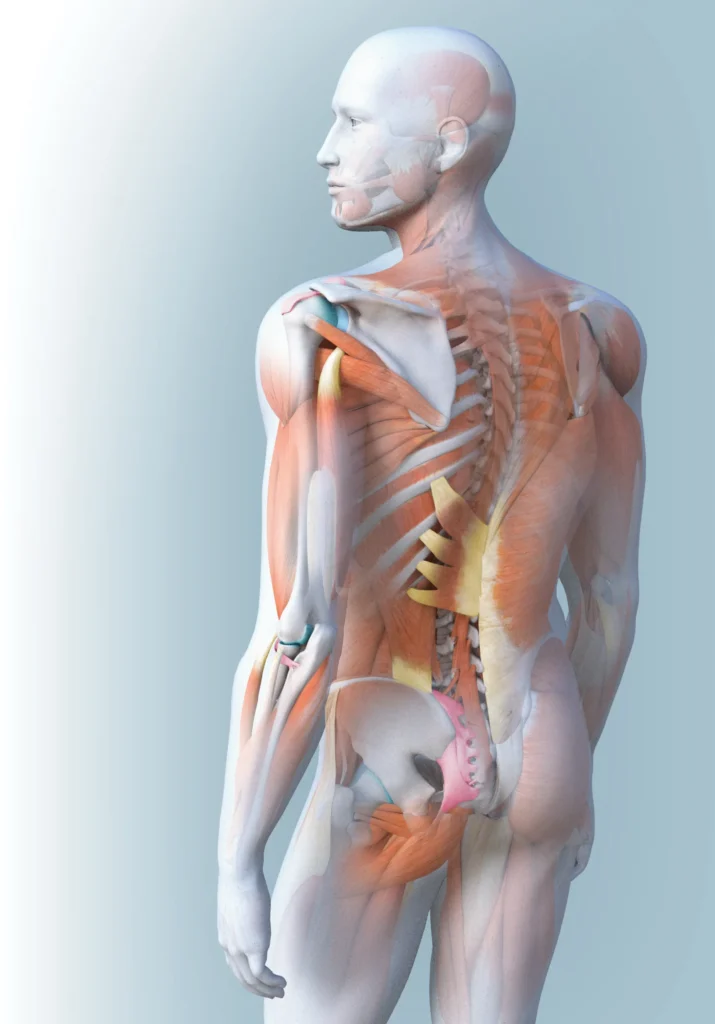
A standard diagram of the human musculoskeletal system might evoke the framework of a house — a sturdy construction of muscle and bone, much like the studs, joists and rafters that give a dwelling structure, determine its shape and protect the valuables held inside.
But that image doesn’t capture the musculoskeletal system’s most remarkable qualities. It’s more than a rigid scaffold on which to hang our soft, pliable bodies.
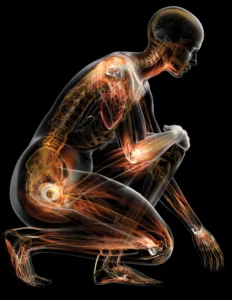
It’s a collection of living, growing, adapting and often self-healing tissues that enable a stunning range of movement, from tickling piano keys to kicking a soccer ball. Imagine a house rising off its foundation, sprinting and doing a backflip.
A healthy musculoskeletal system is what enables people to move. “The burden of musculoskeletal disease is huge,” said William Maloney, MD, the Boswell Chair of Orthopaedics. “It severely impacts people’s quality of life, and it affects more people than does cancer or heart disease.”
According to the World Health Organization, musculoskeletal conditions affect some 1.7 billion people worldwide — more than 20% of the population — and are the leading contributors to disability. Some 570 million people suffer from low back pain, 528 million from osteoarthritis and 440 million from the acute or long-term consequences of broken bones.
“Mobility is key to life,” said Constance Chu, MD, the Elsbach-Richards Professor in Surgery and vice chair of research in the department of orthopaedic surgery. “It’s very, very difficult for the majority of people to work, to maintain social relationships, to exercise, to take care of themselves if they lose mobility or have chronic musculoskeletal pain.”
Key takeways
- Mobility is fundamental to health — and it’s under threat worldwide. Musculoskeletal conditions affect more than 20% of the global population and are the leading contributors to disability, disrupting people’s ability to work, exercise, maintain relationships and care for themselves.
- The musculoskeletal system is living, dynamic tissue — not just a rigid frame. Bone, muscle, cartilage, tendons and ligaments constantly grow and adapt, and they often self-heal, though their capacity varies widely. Muscle can repair in days to weeks, while cartilage has essentially no ability to regenerate.
- The next frontier is prevention. Surgeons excel at fixing injuries and many forms of age-related wear and tear, but the greater challenge is developing treatments that slow or reverse the underlying disease processes — such as osteoporosis, sarcopenia and osteoarthritis.
For nearly as long as people have incurred broken bones, people have also tried to mend them. Evidence of healed fractures that likely required splinting and stabilization date back to Neolithic times. Around 1600 B.C., ancient Egyptians inscribed onto papyrus the earliest known instructions for treating bone injuries.
“Orthopaedics is a very broad specialty,” Maloney said. “It includes everything from the tips of your fingers to the tips of your toes. It’s everything from primary care to highly specialized quaternary care, from people who have routine ankle sprains to people who need half their pelvis taken out for malignant bone cancer.”
To maintain mobility, surgery is only part of the story. Physiatrists employ nonsurgical treatments, such as injections and physical therapy, to restore function and manage pain.
And researchers in areas ranging from biomechanics to endocrinology to regenerative medicine are venturing into the inner workings of musculoskeletal tissues, learning to keep bones strong, fend off infections in prosthetic joints and coax worn cartilage back to life.
Main musculoskeletal components
The adult human body has more than 200 bones, some 650 muscles, roughly 900 ligaments, thousands of tendons and about 250 movable joints. Here’s a closer look at the main components musculoskeletal specialists heal, repair or replace:
Bones under
reconstruction
Bone is a strong yet relatively lightweight material that is largely an extracellular matrix composed of about 30% collagen and 70% calcium- and phosphorus-rich crystals known as hydroxyapatite. Three types of bone cells live within this extracellular matrix: osteoblasts, which build new bone structure; osteoclasts, which tear it down for remodeling; and osteocytes, mature bone cells that detect mechanical stress.
Healthy bone is in a constant state of reconstruction, with extra fortifications directed to areas of high mechanical stress.
Bone is somewhat porous, providing access to networks of small blood vessels that feed the bone cells, and sensory nerves, both inside and on the bone surface, that make a fracture extremely painful.
Cavities inside bone also house a gelatinous substance known as bone marrow, which serves as the birthplace of most of our blood cells.
Muscles in motion
Muscle — specifically skeletal muscle, which is the type under our voluntary control — consists of bundles of long, stretchy cells. These oxygen-hungry muscle cells are fed by rich networks of blood vessels and are connected to both motor neurons, which carry instructions from the brain and spinal cord, and sensory neurons, which carry pain and other signals back to the brain and spinal cord.
Each muscle cell is packed with two key types of protein filaments: actin and myosin. When nerves send an electrical signal, the muscle cells are flooded with calcium ions, which trigger actin and myosin to slide against and grip each other, causing the muscle to contract.
If muscle is torn, whether through intentional exercise or accidental injury, blood and nearby stem cells rush in to repair the damaged tissue in days to weeks — one of the body’s more impressive feats.
Cartilage: a matrix
of collagen
Cartilage is a flexible, slippery, water-retaining tissue that lines the ends of bones at joints to reduce friction and absorb shock. It’s made up of a collagen extracellular matrix filled with large water-trapping molecules known as proteoglycans. Unlike bone and muscle, cartilage lacks blood vessels and nerves — making it a particular problem child for orthopaedics.
A few cells interspersed in the collagen matrix, known as chondrocytes, survive on oxygen and nutrients from the synovial fluid that lubricates joints. They help maintain cartilage to a limited extent, but damaged cartilage has essentially no ability to regenerate.
Because cartilage feels no pain and its watery composition doesn’t show up well on imaging, many people discover their cartilage is gone only when they feel joint pain from bone scraping on bone.
Tendons’ drive
to connect
Tendons and ligaments are essential accessories to muscle and bone, like the screws and brackets that hold the whole assemblage together. Both consist of strong bands of collagen maintained by cells known as fibroblasts.
Tendons connect muscle to bone, translating muscle contractions into movement. The Achilles tendon, for example, connects the calf muscles to the heel bone.
Ligaments: the great
stabilizers
Ligaments are a bit more elastic and connect bone to bone, stabilizing movement at joints. (Joints, the confluence of bone, cartilage, tendons and ligaments, arguably account for the most significant orthopaedic problems, Chu said.) The anterior cruciate ligament, or ACL, for example, connects the femur to the tibia and helps prevent the knee from twisting.
These tough, sinewy connective tissues (sinew is, in fact, an old term that refers to both tendon and ligament) undergo constant mechanical stress and are among the most frequently injured components of the musculoskeletal system. Unfortunately, a relatively poor blood supply to these tissues means injuries are slow to heal.
New frontiers
Orthopaedic surgeons today are adept at fixing catastrophic failures of the musculoskeletal system, and demand has never been higher. “The types of problems we treat often have immediate results,” said Raffi Avedian, MD, an associate professor of orthopaedic surgery and vice chair of education for the department. “If someone has an injury, say they have broken bones and can’t walk, their life changes fundamentally. But within a defined treatment course, we can have folks back on their feet and get their lives back.”
Every year, more than half a million people in the U.S. undergo total hip replacement surgery (one consequence of worn-out joint cartilage). What used to require a weeklong stay in the hospital is often an outpatient procedure now, thanks to faster, less invasive techniques. “It’s a life-changing operation that works very well,” Avedian said.
But the most challenging frontiers of orthopaedic medicine are the underlying aging and disease processes that gradually weaken bone, muscle, tendons, ligaments and cartilage — the fissures that lead to the faults. Osteoporosis occurs when osteoclasts reabsorb bone faster than osteoblasts can replace it, causing bone to become hollow and brittle.
“People no longer tolerate not being able to be active and travel and exercise. They don’t accept being sedentary.”
William Maloney, MD, the Boswell Chair of Orthopaedics
Sarcopenia is age-related loss of skeletal muscle mass and its regenerative abilities. Osteoarthritis, the most common of the three, is the weakening and wearing down of joint cartilage from use, leading to inflammation and painful friction at joints and often immobility.
The hope is to slow or even reverse these conditions before they lead to broken bones and worn-out joints that require surgical intervention. But truly disease-modifying treatments have yet to reach the clinic. Success will likely depend on matching each patient with the right regenerative treatment for them, Maloney said.
Our musculoskeletal system was made to move. In utero, without adequate fetal movement, joints do not form properly or even at all. Throughout life, bone and muscle gain strength from use. And increasingly, innovations in orthopaedic surgery and research are extending people’s mobility past injury, illness and well into old age.
“The average age of my patients has grown 10 or 15 years over the last 20 years,” Maloney said. It’s not unusual for an 80-year-old today to seek out a knee replacement so they can keep hiking, biking, playing tennis and walking 18 holes of golf. “People no longer tolerate not being able to be active and travel and exercise. They don’t accept being sedentary.”
Now, with some help, this old house can keep moving.