

Considering assembloids and organoids
A conference organized by Stanford University tackled bioethical questions raised by new technologies for replicating brain parts in a dish
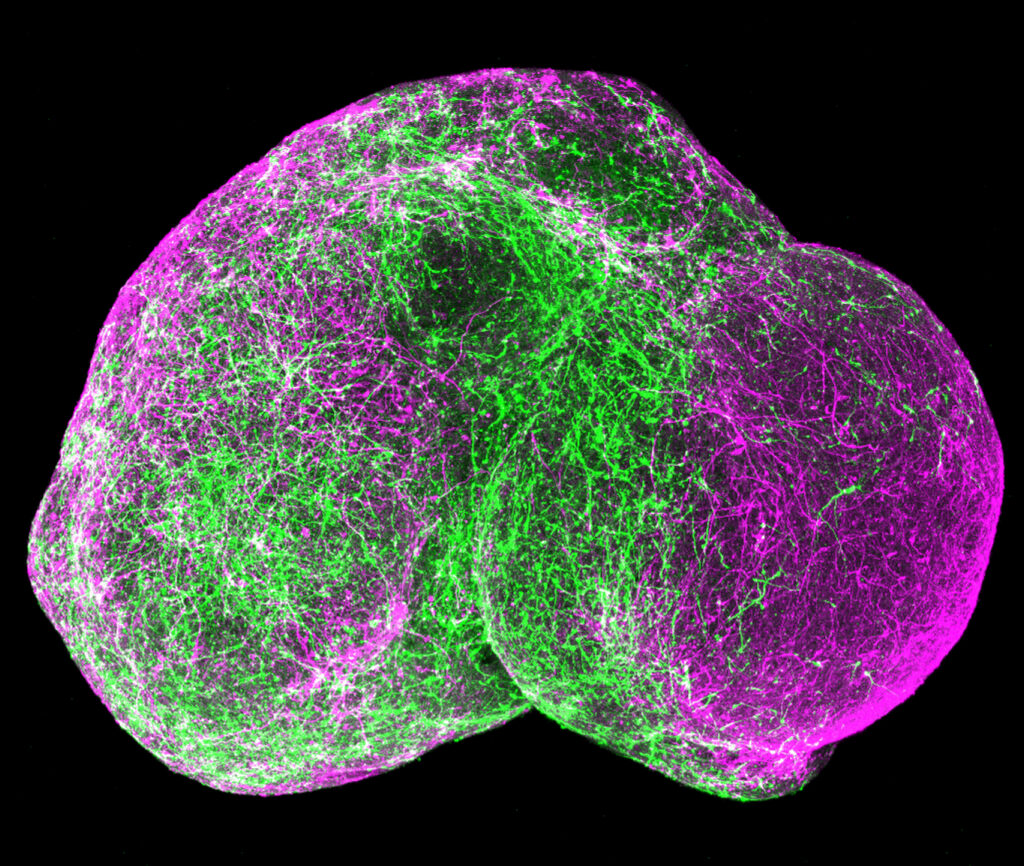
Over the past nearly two decades, stem-cell technology has enabled brain scientists to, as if by magic, transform virtually any living person’s skin cells into diverse types of brain cells that, following their own hardwired instructions, coalesce into tiny spheres recapitulating different brain regions’ structure and connectivity.
These tissue replicas, or neural organoids, can be strung together into interconnected concatenations called neural assembloids, which mimic the interplay between different brain regions. They allow neuroscientists to better understand neurodevelopmental disorders and the effects of oxygen deprivation or viral infections on the fetal brain.
From the archives
By re-creating neural pathway in dish, Stanford Medicine research may speed pain treatment
Organoid brain models yield insights into resilience
Human brain cells transplanted into rat brains hold promise for neuropsychiatric research
Here come the assembloids
This profound access to aspects of human neurobiology, difficult to impossible to study otherwise, promises treatments for severe conditions once thought intractable. But the field’s rapid expansion raises concerns about the ethical and societal implications of neural organoids, assembloids, their transplantation into other species’ brains for experimentation and more.
“Technical advances, recent and imminent, are going to bring more attention to this field,” said professor of law Hank Greely, JD, a longtime observer of looming bioethical quandaries.
As assembloid advances permit increased communication among different brain parts in a dish, and as animal transplantation or improved culture methods enhance organoid and assembloid development, might these laboratory tools become sentient — experience subjective sensations of pain, for instance, or even some form of consciousness? Will hookups between animals’ brains and transplanted brain tissue of human origin trigger any unexpected, emergent properties, such as humanlike behaviors, in these animals?
Another issue: With a projected rapid expansion in the array of experiments that can be performed with organoids and assembloids, what additional steps should be taken to ensure that tissue donors’ intentions are honored? Should they or their guardians be informed whenever new technologies enable their cells to be used to generate more-complex organoids, assembloids or interspecies hybrids?
“Patient advocates articulated with striking clarity how urgent the need is for therapeutic advances and how important it is that ethical reflection does not become disconnected from the realities faced by affected families.”
Sergiu Pasca, MD, a professor of psychiatry and behavioral sciences
To brainstorm about these concerns and whether regulations are needed — and if so, what they should be — Greely and Sergiu Pasca, MD, a professor of psychiatry and behavioral sciences and a neural-assembloid pioneer, spearheaded a conference, held Nov. 10 through 12, 2025, at Asilomar in Pacific Grove, California.
The meeting brought together nearly 70 participants from the U.S., Europe and Asia, including neuroscientists, cognitive psychologists, philosophers, legal scholars, ethicists, editors of major scientific journals, journalists, patient advocates and representatives from scientific organizations.
It was organized with support from the Dana Foundation and the Wu Tsai Neuroscience Institute, for which Pasca serves as the Uytengsu Family Director of the Stanford Brain Organogenesis Program. This initiative, launched in 2018, brings Pasca, Greely and others together to keep ethics at the core of brain organoid and assembloid advances.
The conference echoed a 1975 conference held at Asilomar — likewise organized by Stanford University scientists and bioethicists — to discuss the scientific, legal and ethical implications of recombinant DNA, or gene splicing.
“Technical advances, recent and imminent, are going to bring more attention to this field.”
Professor of law Hank Greely, JD
That new technology burgeoned and spawned everything from miraculous biotechnological cures to fears that the course of human evolution could be deliberately, and perhaps dangerously, altered.
At the 2025 conference, Greely said, participants largely agreed that the ethical questions regarding organoids and assembloids need more attention and that the public should be made aware of both the limits and capabilities of the technologies.
However, another message that resonated broadly was that ethical considerations must not overshadow the impetus behind these scientific developments.
“Patient advocates articulated with striking clarity how urgent the need is for therapeutic advances and how important it is that ethical reflection does not become disconnected from the realities faced by affected families,” said Pasca, the Kenneth T. Norris, Jr. Professor II of Psychiatry and Behavioral Sciences.
In the wake of the conference, the organizers’ focus has turned to synthesis. They are now assimilating the insights and planning what comes next.
