


‘We need a breakthrough’
Trials of immunotherapy for ovarian cancer offer hope for patients with few options
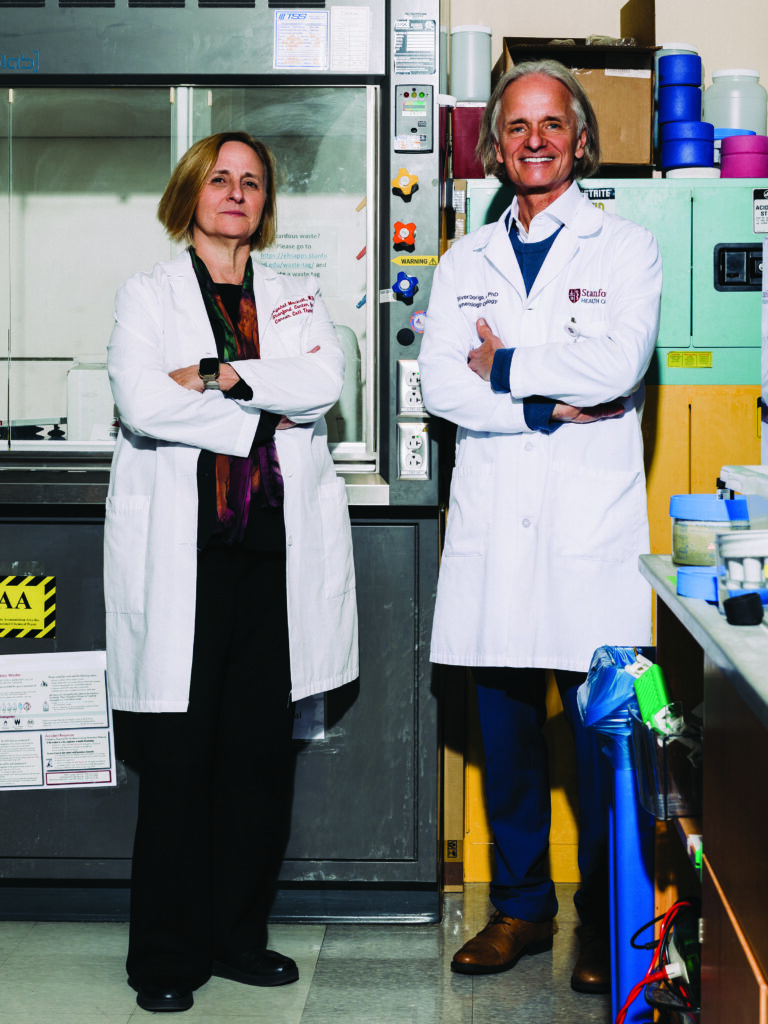
Every day, Oliver Dorigo, MD, PhD, has to confront the challenge of treating ovarian cancer, which is a frustratingly stubborn disease to manage. It’s hard to detect, at times resistant to drug treatment and, all too often, fatal.
“I don’t accept the fact that at least 60% of patients with ovarian cancer die from the disease. We need to change that. That has been my mission for decades,” said Dorigo, the Mary Lake Polan Professor at Stanford Medicine. “I’m very optimistic that there will be a time when we will be able to offer patients more effective therapies.”
That optimism springs from Dorigo’s recent work with two innovative therapies now in clinical trials that he hopes will improve the outlook for patients with the disease, one of the deadliest cancers among women. Some 21,000 women are diagnosed with ovarian cancer every year in the United States and, in 2026 alone, some 12,450 are expected to die from it, according to the American Cancer Society.
Because no definitive screening tools exist, patients are often diagnosed when the cancer is advanced, making it particularly difficult to treat, said Dorigo, director of the gynecologic oncology division.
Patients might initially respond to treatment, which typically includes surgery and multiple rounds of chemotherapy. But the cancer frequently returns and can cause patients to become resistant to drug treatment, leaving them with few therapeutic options, he said. Among patients with advanced disease, only about one-third live at least five years.
To change that, Dorigo and his colleagues have turned to CAR-T (chimeric antigen receptor) cell therapy, which is transforming cancer treatment. The therapy empowers a patient’s own immune system to attack cancer cells. It has been used with tremendous success in blood cancers, with clinicians just starting to test it in solid tumors.
“I don’t accept the fact that at least 60% of patients with ovarian cancer die from the disease. We need to change that. That has been my mission for decades.”
Oliver Dorigo, MD, PhD, the Mary Lake Polan Professor at Stanford Medicine
“Ovarian cancer is one of these cancers that has been left behind in the immunotherapy revolution. It’s unfortunate because we need a breakthrough,” said Crystal Mackall, MD, founding director of the Stanford Center for Cancer Cell Therapy and a national leader in the field. “There’s no reason we shouldn’t be able to apply this in ovarian cancer.”
The therapy, which they are testing in a clinical trial, targets a protein called B7-H3, which is expressed in 90% of ovarian cancers, Mackall said. During treatment, clinicians extract a patient’s white blood cells — the disease fighters of the immune system — and genetically modify them in the lab to recognize the B7-H3 protein. The new, highly active cells are then infused into the patient so they can zero in on and destroy cancerous cells.
Ovarian cancer is often confined to the abdomen, so clinicians can infuse the cells directly into that area using a soft tube, thus sparing other tissues.
“This might have an advantage,” said Mackall, the Ernest and Amelia Gallo Family Professor and a professor of pediatrics and of medicine, who is collaborating in the trial. “We have seen this in brain tumors. Giving the CAR-T cells directly into the brain is shown to have benefit.”
The researchers began the trial in late 2024 and have tested the treatment in seven patients, all with advanced, recurring disease that has resisted all other therapies. In all patients, the tumors stopped growing for some time, and in some, tumors decreased after two months, Dorigo said. “We have definitely seen initial benefits to patients — some positive signals,” he said.
Dorigo noted that some patients in the trial experienced side effects related to the hyperactivity of the T cells, which can cause fever, low blood cell counts and leg swelling. To reduce these side effects, the research team has lowered the dose of the CAR-T cells.
That made the treatment more tolerable while still controlling tumor growth, Dorigo said. Patients receive as many as three infusions to maximize the impact of the CAR-T cells, he said. The researchers now plan to treat up to 10 additional patients in the trial at the lower dose.
“Ovarian cancer is one of these cancers that has been left behind in the immunotherapy revolution. It’s unfortunate because we need a breakthrough. There’s no reason we shouldn’t be able to apply this in ovarian cancer.”
Crystal Mackall, MD, founding director of the Stanford Center for Cancer Cell Therapy
By summer 2026, the researchers may also begin using a next-generation CAR-T cell whose activity can be regulated through a daily pill that turns the T cells on and off, Mackall said.
This approach, developed in her laboratory, enables patients to use the pill to tune the potency of the T cells. For instance, a patient who begins to experience toxic side effects can stop taking the pill for a few days to modulate the dose and eliminate the toxicity, Mackall said.
She believes the trial is a good starting point for treating a disease with an urgent need for new approaches.
“I think it’s an exciting target in a disease that doesn’t have a lot of options,” she said. “This is something we can offer to the field that has yet to be available. One of the advantages is that we have a great team focused on women’s cancers. I can’t emphasize that enough. It allows us to learn a lot from our patients. I think this is step one. We are in it for the long haul.”
Because this trial was initiated by Stanford Medicine, using a $5 million gift from a donor, the researchers have full control over how it’s conducted.
“We are the ones who can modify the treatment on our study protocol,” Dorigo said. “We can therefore be very flexible and react to clinical observations quickly. It’s very different when a company sponsors a trial, where we are subject to their strategies and thinking.”
In a separate effort, Dorigo is testing an antibody discovered in the laboratory of Irving Weissman, MD, the Virginia & D.K. Ludwig Professor in Clinical Investigation in Cancer Research at Stanford Medicine, and his colleagues. He’s participating in a multi-center trial sponsored by Pheast Therapeutics Inc., which was co-founded by scientists who trained in Weissman’s lab.
Weissman’s team identified a protein on the surface of cancer cells, called CD24, that allows them to escape destruction by immune cells called macrophages. The researchers devised an anti-CD24 antibody that removes this obstacle, allowing the macrophages to gobble up and destroy the cells.
Ovarian cancer is a good target for this therapy, Dorigo said, as these tumors express high levels of CD24 and contain a lot of macrophages. So far, five patients have been treated with the anti-CD24 antibody at the Stanford Women’s Cancer Center. The goal is to determine if the drug is safe and shows any anti-tumor activity. The trial began in July 2025 so it’s too early to draw conclusions. Patients treated at Stanford and other institutions have tolerated the treatment well so far, Dorigo said.
These two Stanford Medicine trials are encouraging, as they represent a whole new direction for immune-based therapies, said Anne Mette Buhl, PhD, senior director for treatment access and scientific education with Ovarian Cancer Research Alliance.
“This is a particularly hopeful time for the ovarian cancer community, as substantial efforts are underway to develop more effective and precise treatment options,” she said.
Spotlight on Crystal Mackall
Professor of pediatrics and of medicine
A pioneer in cancer immunotherapy, Crystal Mackall was among the first to show the value of CAR-T cells in pediatric leukemia, while working at the National Institutes of Health. More recently, she and Stanford Medicine colleagues showed these cells could be used to treat certain brain tumors. She has published multiple landmark papers in the field.
- Came to Stanford Medicine in 2016 from the NIH and founded the Center for Cancer Cell Therapy in 2017.
- Grew up in northeastern Ohio, in a working-class family. Received her MD degree from Northeast Ohio Medical University.
- Recharges by spending time with family, hiking, doing other outdoor activities, reading and enjoying a good meal.
In her words: “This work matters to me because I believe that cell therapies can have activity on more common solid cancers where we have major unmet needs. I think ovarian cancer is a good setting to test that.”
Spotlight on Oliver Dorigo
Director of the gynecologic oncology division
Oliver Dorigo treats patients with gynecologic cancers, including ovarian, cervical, endometrial, vaginal and vulva cancer. His research and the clinical trials he leads are designed to develop and study new immunotherapies for patients with ovarian cancer.
- Received his MD degree from the University of Heidelberg in Germany and a PhD in molecular biology from the University of California, Los Angeles.
- Was born and raised in Germany by a German mother and an Italian father, and still visits family in Italy and Germany.
- Has completed 21 full Ironman triathlons (2.4 miles swimming, 112 miles cycling, 26.2 miles running). To relax, he bikes, runs, swims, skis, surfs and spends time with family, including his three teenagers. “Everybody needs something to get their minds off the very challenging situations we encounter in patient care. Sports and family keep me active and give me something to look forward to.”
In his words: “I’ve treated ovarian cancer for decades. I see every day how challenging this treatment is for the patients and their families. We still lose way too many patients to this disease. For the patients and even for myself, it’s extremely frustrating to come to the end with no more options. We need more cures. With time, I am confident that we will get there.”
